Biosynthetic Pathway: Dark Reaction
Both NADPH2 and ATP produced during light reaction are essential requirements for synthesis of carbohydrates. These series of reactions which catalyse the reduction of CO2 to carbohydrates (also called fixation of CO2) take place in the stroma of the chloroplast.
These reactions are independent of light i.e. light is not necessary but can continue in light as well if products of the light reaciton are available. Thus it is also called dark reaction.
The carbon fixation reactions produce sugar in the leaves of the plant from where it is exported to other tissues of the plant as source of both organic molecule and energy for growth and metabolism. There are two major pathways by which CO2 fixation (Dark reaction) takes place.
C3 Cycle (Calvin Cycle)
In this cycle, initially the atmospheric CO2 is accepted by a 5-carbon sugar ribulose bisphosphate (RuBP) resulting in the generation of two molecules of 3-carbon compound, 3-phosphoglyceric acid (PGA). This 3-carbon molecule is the first stable product of this pathway and hence the name C3 cycle is given. Formation of PGA is called carboxylation. This reaction is catalysed by an enzyme called ribulose bisphosphate carboxylase/ oxygenase or Rubisco. This enzyme is probably the most abundant protein on earth.
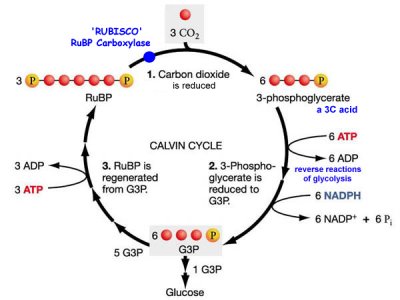
In the next step, PGA is reduced to 3-carbon carbohydrate called triose phosphate using NADPH2 and ATP (from light reaction). Much of these molecules are then diverted from the C3 cycle and used for synthesis of other carbohydrates such as glucose and sucrose.
To complete the cycle, the initial 5-carbon acceptor molecule, RuBP is regenerated from the triose phosphates using ATP molecule thus the C3 cycle continues to regenerate the CO2-acceptor (RuBP).
C4 Cycle (Hatch Slack Cycle)
The C4 cycle seems to be an adaptation for plants growing under dry hot environment. Such plants can photosynthesize even in the conditions of very low CO2 concentration and under partial closure of stomata. Such plants can thus grow at low water content, high temperature and high light intensity. Sugarcane and maize are some examples.
Photorespiration (oxidation of RuBP in presence of O2) is absent in these plants. So the photosynthetic rate is high.
The leaves of C4 plants show presence of dimorphic chloroplasts, called Kranz anatomy. In these plants, the vascular bundles have a sheath of large parenchyma cells around them in the form of a wreath. Leaves possess two types of chloroplasts (dimorphic chloroplasts). Chloroplasts in the mesophyll cells are smaller and have well developed grana (granal chloroplasts) but do not accumulate starch. Chloroplasts in the bundle sheath cells are larger and lack grana (agranal chloroplasts) but contain numerous starch grains.
In C4lants, the initial acceptor of CO2 is phosphoenol pyruvic acid or PEP, a 3-carbon compound. It combines with CO2 in presence of an enzyme Phosphoenol pyruvate carboxylase (PEP carboxylase) and forms a C4 acid, oxaloacetic acid (OAA). This fixation of CO2 occurs in the cytosol of the mesophyll cells of the leaf. OAA is the first stable product of this cycle which is 4 carbon compound and hence the name C4 pathway is given.
OAA then travels from mesophyll cells to the chloroplasts of bundle sheath cell where it releases the fixed CO2. In C4 pathway of dark reaction, there are two carboxylase enzymes that take part. PEP carboxylase (PEPCo) in the mesophyll cells and RUBP carboxylase (Rubisco) in the bundle sheath cells.