Human Digestive System
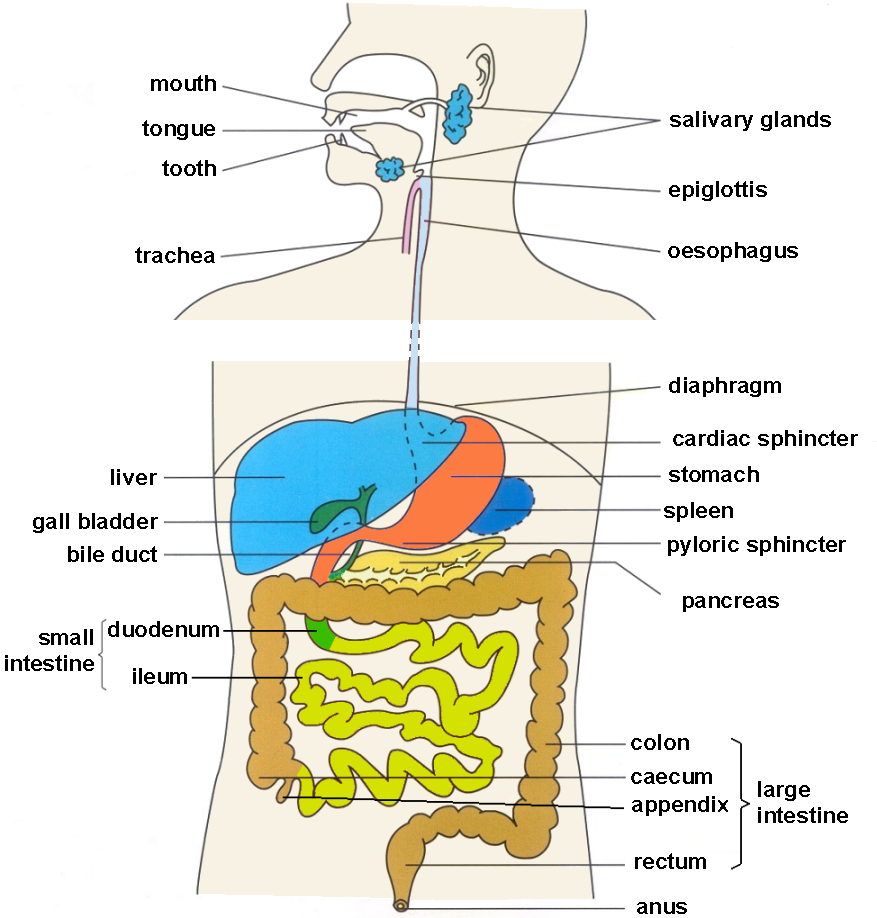
The digestive system in humans consists of an alimentary canal and associated digestive glands. The human alimentary canal is a continuous muscular digestive tube that runs through the body. It is open at two ends with the openings, which are mouth at anterior end and anus at posterior end. It digests the food, breaks it down into smaller substances, and absorbs the digested food.
Parts of Alimentary Canal
1. Mouth and associated organs (teeth, tongue)
2. Pharynx (or throat): A cavity at the back of the mouth. It is a common passage for the inhaled air and the swallowed food.
3. Oesophagus: A narrow tube arising from pharynx, continuing through the thorax and ending in the stomach.
4. Stomach: An elastic bag with highly muscular walls, located below the diaphragm.
5. Small intestine: Longest part of alimentary canal, a tube about 7 meters long and about 2.5 cm wide. Much coiled and folded, it is contained in the abdomen. Its three subdivisions are:
- (i) Duodenum - Short upper part, next to stomach
- (ii) Jejunum - Slightly longer part, about 2 meters long
- (iii) Ileum - Longest, about 4 meters long, coiled and twisted
6. Large Intestine: About 1.5 meters long and has three parts.
- (i) Caecum - Small blind pouch at the junction of small and large intestine. A narrow worm-shaped tube (vermiform appendix) projects from the caecum.
- (ii) Colon: A little over 1 meter long, it has three parts termed ascending, transverse and descending limbs of the colon.
- (iii) Rectum: Last part, about 15 cm. long. It has two parts, the rectum proper and anal canal. Anus is the external opening surrounded by circular muscles (sphincters).
Digestive Glands (Sources of digestive enzymes)
There are two sources of digestive enzymes:
- The glandular cells of the lining of stomach and intestine, which directly pour their secretion into the lumen of the gut or the alimentary canal.
- Special glands such as the salivary glands, the liver and the pancreas which pour their secretions into the gut through their ducts.
The mouth is always moist, even on a hot summer day because there is a watery fluid called saliva which is secreted by salivary glands into the mouth cavity. It is this saliva, that keeps the mouth moist all the time.
Salivary Glands
There are three pairs of Salivary glands in mouth cavity:
- Parotid glands located in front of and below each ear, produces watery saliva rich in amylase (Starch digesting enzyme)
- Submaxillary glands close to inner side of lower jaw, produce water and mucus.
- Sublingual glands below the tongue, produce water and mucus.
These glands continuously pour saliva into the mouth cavity. The amount of saliva secreted is about 1000 to 1200 ml per day.
Functions of Saliva
- It cleans the mouth cavity and tends to destroy germs with its lysozymes that cause teeth decay.
- It moistens and lubricates food which helps in swallowing.
- It acts as solvent, dissolving some food particles to stimulate taste buds of the tongue.
- Saliva helps in the digestion of food as it contains an enzyme salivary amylase which digests starch converting it into sucrose. That is why starch when chewed leaves a sweet taste in the mouth.
Liver
Liver is the largest gland, located in the upper right side of the abdomen below the diaphragm. It secretes bile, which gets collected in gall bladder and is finally poured into the duodenum through the common bile duct. Besides secreting bile, which helps in digestion, the liver has numerous other functions.
Pancreas
Pancreas is a reddish brown gland located in the bend of the duodenum. Its digestive secretion (pancreatic juice) is poured into the duodenum by the pancreatic duct.