Renin-angiotensin and Atrial Natriuretic Factor
Renin-angiotensin is part of a feedback circuit which helps to regulate blood pressure and blood volume. Nephron, the structural and functional unit of the human kidney has a cluster of capillaries called glomerulus. Near the arteriole supplying the glomerulus lies a specialized tissue called juxtaglomerular apparatus (JGA).
When blood pressure or blood volume in the afferent arteriole drops, JGA secretes as enzyme called renin. Renin converts a plasma protein called angiotensinogen into angiotensin II which acts like a hormone, constricts the arteriole, which in turn elevates the blood pressure.
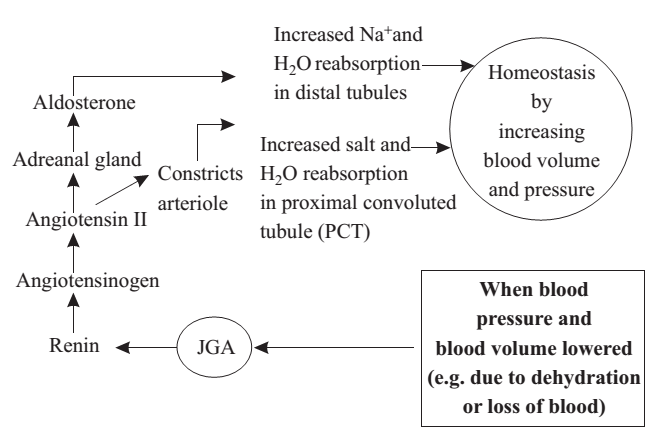
Angiotensin II also stimulates the proximal convoluted tubules (PCT) of nephron to reabsorb more salt and water so that salt and water excreted in the urine are reduced. As a consequence, blood volume and blood pressure both increase. Angiotensin II also stimulates adrenal gland to release the hormone Aldosterone which makes distal tubules of nephron to reabsorb sodium and water. This also increases blood volume and blood pressure.
Anti Natriuretic Factor
Antinatriuretic factor is a powerful vasodilator and is a polypeptide hormone secreted by the cells of heart muscles (myocytes or muscle cells). It is released in the atria of the heart in response to the high blood pressure and is involved in the homeostatic control of water, sodium, potassium and fat in the body.