Transpiration
The loss of water from aerial parts of the plant in the form of water vapour is termed transpiration. When transpiration is low and absorption of water by roots is high, loss of water from leaves in the form of liquid is termed guttation.
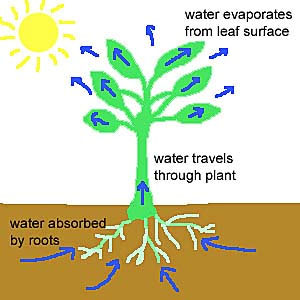
Transpiration may occur through three main sites in the plant:
- Cuticle
- Lenticels
- Stomata
Cuticle
Cuticle is the waxy covering of the epidermis of leaves and green herbaceous stems. Though it is meant to check transpiration, still about 10% of the total transpiration may take place through fine cuticular pores, and the process is known as cuticular transpiration.
Lenticels
Lenticels are areas in the bark of stems, branches and fleshy fruits which are made up of loosely arranged cells that account for about 0.1 percent of water loss. It is known as lenticular transpiration.
Stomata
Stomata are minute pores on the epidermis of leaves, or tender green stems, whose opening and closing are controlled by guard cells. About 90 percent of water loss from plants takes place through stomata by the process known as stomatal transpiration.
Mechanism of Transpiration
Transpiration occurs in two stages:
- (i) Evaporation of water from the cell walls of mesophyll cells into the intercellular spaces.
- (ii) Diffusion of this water vapour of the inter cellular spaces into the outside atmosphere, through cuticles, lenticels and stomata, when the outside atmosphere is drier.