Levels of Management
There are certain levels of management with varying degree of authority and responsibilities. Some managers decide about the objectives of the business as a whole; some managers perform functions to achieve these objectives in different departments, like production, sales, etc, and some of the managers are concerned with the supervision of day-to-day activities of workers.
Managers performing different types of duties may be divided into three categories:
- Top-Level Management
- Middle-Level Management
- Lower-Level Management
The top level management includes Board of Directors and the Chief Executive. The chief executive may have the designation of Chairman, Managing Director, President, Executive Director or General Manager. This level determines the objectives of the business as a whole and lays down policies to achieve these objectives (making of policy means providing guidelines for actions and decision). The top management also exercises an overall control over the organisation.
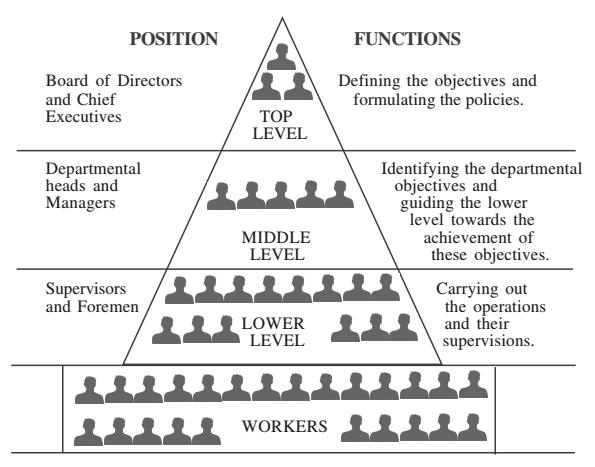
The middle-level management includes heads of various departments, e.g., production, sales, etc., and other departmental managers. Sometimes senior departmental heads are included in the top management team. The objectives of the business as a whole are translated into departmental objectives for the middle level management. The heads of the departments then work out their own strategies so as to achieve these objectives. Middle-level managers are particularly concerned with the activities of their respective departments.
The lower-level management consists of foremen and supervisors who look after the operative workers, and ensure that the work is carried out properly and on time. Thus, they have the primary responsibility for the actual production of goods and services in the organisation.
These three levels of management taken together form the ‘hierarchy of management’. It indicates the ranks and positions of managers in the hierarchy. It shows that the middle-level management is subordinate to the top-level and that the lower-level is subordinate to the middle-level management.
The number of people at each level increases as one moves from top to bottom. Workers including crafts persons, manual labourers, engineers, scientists, etc. form the bulk of the organisation membership. Within the managerial ranks, the number of managers at each level decreases as one moves from lower-level to top-level management. At the top of the organisation, there is usually one person.