Asexual Reproduction
Reproduction by single individuals takes place in many ways in lower organisms like bacteria and protozoa and some algae. In plants, asexual reproduction is by vegetative propagation. Animals like sponges and hydra reproduce both asexually and sexually.
1. Asexual Reproduction in Lower Organisms
Asexual reproduction is of various types:
A. Binary Fission
A cell may divide to give rise to two individuals and lose its own identity as in binary fission that takes place in amoeba and bacteria.

B. Budding
In budding, a bud forms from the body of the mother cell and remains attached to it. The parental nucleus elongates and then divides into two, one of which moves into the bud. Example: yeast.

In animals like sponges and hydra which are multi-cellular; a bud arises from some part of the body, enlarges and then detaches from the parent body after all its body parts have been formed.

C. Spore Formation
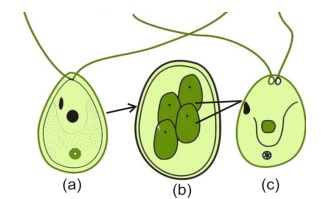
The cytoplasm and nucleus of algae such as Chlamydomonas divide successively to form 4 to 8 spores. Spores are also formed for reproduction in fungus, moss and fern. Spores are single cells which upon their release from the parent plant develop into new individuals.
2. Asexual Reproduction in Plants
Vegetative Propagation
In nature, new plants may arise from root, stem or leaves (from the vegetative parts of the plant). This form of asexual reproduction in plants is termed vegetative propagation.
New plants may be formed from roots or stem or leaves or when a stem grows to a distance and then enters soil and strikes roots to form a new plant.
3. Artificial Propagation in Plants
Humans have taken hints from natural methods of vegetative propagation to grow many plants through artificial propagation.
A. Cutting: A piece of branch is cut and embedded in the soil. Roots form and a new plant results.
B. Layering: A branch of the plant is laid on the ground and a portion is embedded in the soil. This part strikes root and gives rise to new plant.
4. Other Methods of Asexual Propagation
In the laboratories, researchers have raised offspring from single parent through tissue culture. Dolly was a sheep, an exact copy of her mother, raised through cloning.
A. Micro Propagation
Researchers have standardized the methods of tissue culture. Every living cell or every part of a plant has been found to be totipotent, that is, it has the potential to give rise to more plants.
All the cells of an individual arise from a single cell, the zygote and hence all cells have the same genes. Genes control growth, development and all the life processes.
From a piece of plant, say root of carrot, or a leaf, cells can now be cultured in adequate nutrient solution to form an undifferentiated mass of cells called callus which can then give rise to new plantlets. The raising of plants through tissue culture is termed micropropagation.
B. Cloning
A clone is the genetic copy of the parent. The sheep Dolly, when born was an exact copy of her mother. Her mother’s udder cell nucleus was transferred into the egg of a "surrogate mother", after removing the nucleus. Dolly’s mother provided her genes while the surrogate mother provided the womb for Dolly to develop from an embryo to a full fledged individual.