Covalent Bonding
Covalent bonding is helpful in understanding the formation of molecules. Molecules have similar atoms such as H2, Cl2, O2, N2 are molecules of elements whereas those containing different atom like HCl, NH3, CH4, CO2 are molecule of compounds. A chemical bond, which is formed by sharing of electrons between the atoms is called a covalent bond.
Hydrogen Molecule (H2)
The hydrogen atom has one electron. It can attain the electronic configuration of the noble gas helium by sharing one electron of another hydrogen atom. When the two hydrogen atoms come closer, there is an attraction between the electrons of one atom and the proton of another and there are repulsions between the electrons as well as the protons of the two hydrogen atoms.
In the beginning, when the two hydrogen atoms approach each other, the potential energy of the system decreases due to the force of attraction. The value of potential energy reaches a minimum at some particular distance between the two atoms. If the distance between the two atoms further decreases, the potential energy increases because of the forces of repulsion.
The covalent bond forms when the forces of attraction and repulsion balance each other and the potential energy is minimum. It is this lowering of energy which leads to the formation of the covalent bond.

Chlorine Molecule (Cl2)
A molecule of chlorine contains two atoms of chlorine. The electronic configuration of Cl atom is 2, 8, 7. Each chlorine atom needs one more electron to complete its octet. If the two chlorine atoms share one of their electrons, then both of them can attain the stable noble gas configuration of argon.
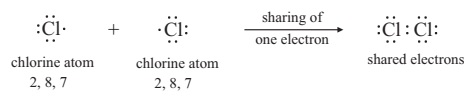
The sharing pair of electrons is shown to be present between the two chlorine atoms. Each chlorine atom thus acquires 8 electrons. The shared pair of electrons keeps the two chlorine atoms bonded together. Such a bond, which is formed by sharing of electrons between the atoms is called a covalent bond. This bond is represented by drawing a line between the two chlorine atoms.
Oxygen Molecule (O2)
The oxygen atom has atomic number 8. It has 8 protons and also 8 electrons. The electronic configuration of oxygen atoms is 2, 6. Now each oxygen atom needs two electrons to complete its octet. The two oxygen atoms share two electrons and complete their octet.

The 4 electrons (or 2 pairs of electrons) which are shared between two atoms of oxygen are present between them. Hence these two pairs of shared electrons can be represented by two bonds between the oxygen atoms. The two oxygen atoms are said to be bonded together by two covalent bonds. Such a bond consisting of two covalent bonds is also known as a double bond.
Nitrogen Molecule (N2)
The atomic number of nitrogen is 7. Thus it has 7 protons and 7 electrons present in its atom. The electronic configuration is 2, 5. To have 8 electrons in the outermost shell, each nitrogen atom requires 3 more electrons. Thus, a sharing of 3 electrons each between the two nitrogen atoms is required.

Each nitrogen atom provides 3 electrons for sharing. Thus, 6 electrons or 3 pairs of electrons are shared between the two nitrogen atoms. Hence, each nitrogen atom is able to complete its octet. Since 6 electrons (or 3 pairs of electrons) are shared between the nitrogen atoms, three covalent bonds are formed between them. These three bonds are represented by drawing three lines between the two nitrogen atoms. Such a bond which consists of three covalent bonds is known as a triple bond.
Hydrogen Chloride
A hydrogen atom has one electron in its outermost shell and a chlorine atom has seven electrons in its outermost shell. Each of these atoms has one electron less than the electronic configuration of the nearest noble gas. If they share one electron pair, then hydrogen can acquire two electrons in its outer most shell whereas chlorine will have eight electrons in its outermost shell.
