Electric Generator
Electric Generator is such a device that converts mechanical energy to electrical energy.
Generators are of two types:
- A.C. Generator (Alternating Current Generator): This produces current that flows in such a manner that its direction and amplitude changes constantly with time.
- D.C. Generator (Direct Current Generator): This generator produces current that flows in the same direction in a continuous manner.
A.C. Generator
A.C. generators operate on the principle of electromagnetic induction. Alternating voltage or current may be generated by rotating a coil in the magnetic field or by rotating a magnetic field with a stationary coil. The value of the voltage or current generated depends on:
- Number of turns in the coil
- Strength of the field
- Speed at which the coil or magnetic field rotates
Structure of an A.C. Generator
ABCD is a nonconductor frame on which copper wire has been coiled several times to form a rectangular coil. The coil is coated with a nonconductor substance like varnish so that they do not touch each other. This coil can freely move between the N-S poles. This rectangular coil is made to rotate between two rings E and F. There are two contact brushes G and H attached to the rings respectively.
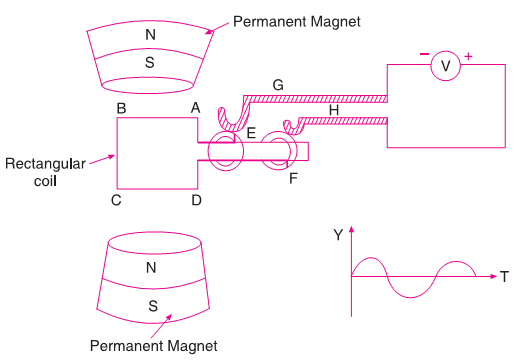
The rectangular frame ABCD moves between the N-S poles due to mechanical energy. The magnetic field entering into the face ABCD of coil increase from zero to some infinite value and continues to increase till the coil becomes normal to the field. The rate, at which the magnetic field liked with coil charges, is the maximum in the beginning and then it decrease continuously. Thus, the induced current in the coil is maximum at time, t = 0 and decrease passing time. When the coil become normal to the field the rate at which magnetic flux of force charges become zero and hence current in the coil is zero.
When the coil further rotates the face of the coil through which magnetic field enters start changing the directing of current reversed. It keeps increasing till the plane of the coil does not become parallel to the magnetic field lines. Thus maximum current flows through the coil at this juncture. If the coil is rotated further, the area in contact with DCBA increase and the rate of change of magnetic field area becomes less.
Thus, the amount of current flowing through the coil decreases. When the coil is perpendicular to the magnetic lines of force then, current becomes zero. Now the north pole of the magnet is reversed. Current starts flowing from its original direction.
D.C. Generator
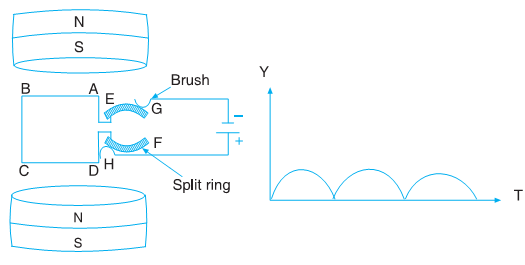
This also works like the AC generator. There is just one difference in its structure. There is a half rectangular rings rather than E and F rings as in AC generators.
The rectangular frame rotates and moves from a position parallel to the magnetic field to an upper one. The brush present creates a connection as electric current starts flowing. The current flows in the same direction.
Alternative Current (AC) and Direct Current (DC)
In household as well as industrial purposes, AC is widely used. The current that flows out from the switch points at homes is AC. The current produced by a battery is DC. AC can be changed to DC and vice versa. To change AC to DC a rectifier is used.
AC is transmitted from electricity generation centers to houses and industries through high voltage transformer (step up transformers) at very high voltage. At the site of delivery like houses and industries the voltage is reduced with the help of step down transformers. In this way transmission cost is reduced as well as wastage of energy is minimized. Transmission of DC causes the loss of a large amount of energy. Transformers cannot be used for DC.
Devices like electric motor that work on AC are stronger than those that use DC. They are also more convenient to use. DC generally used in electrolysis, changing the cells, making electromagnet.
DC of same voltage as AC is more dangerous because in DC direction of flow of current doesn’t change. Thus people coming in contact with DC accidentally get stuck to it while when the come in contact with AC, due to change in direction of flow of current they are flung afar.
Major portion of AC flows through the upper portion of a wire. Thus where a thick wire has to be installed, several thin wires are coiled together to form a thick wire which will not the case with DC.