Prokaryotic are Eukaryotic Cells
A cell is the structural and functional unit of all living beings. All cells have three basic parts.
-
Cell membrane which limits the cell and gives it shape.
-
DNA which may be contained in a nucleus.
-
Fluid called cytoplasm filling in the space within the cell.
Whether DNA of the cell lies in the cytoplasm or is enclosed within a nuclear membrane, cells are termed prokaryotic or eukaryotic.
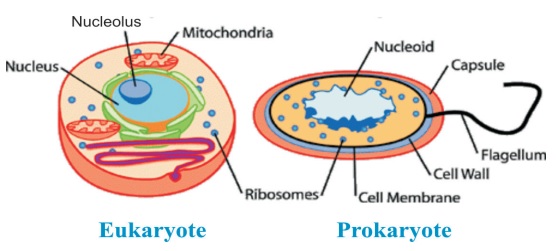
Prokaryotic Cell
Pro - before; karyon - nucleus
These cells do not have a well-organized nucleus. The genetic material is a single molecule of DNA lying in the cytoplasm. Cell organelles like mitochondria, lysosomes, endoplasmic reticulum, chloroplast, nucleolus, etc. are also not present in prokaryotic cells. Examples: Bacteria and blue-green algae.
Eukaryotic Cell
Eu - true; karyon - nucleus
DNA is enclosed in a nuclear membrane forming a nucleus. The genetic material is made of two or more DNA molecules, which are present as a network of chromatin fibres when the cell is not dividing. Membrane-bound organelles, such as mitochondria, endoplasmic reticulum, lysosome, chloroplast, nucleolus, etc. are present within the cytoplasm. Examples: Cells of plants, fungi, protozoa and animals.