States of Matter
Matter can ordinarily exist in three states - solid, liquid and gas. These three states of matter have different properties. Water exists in all the three states namely steam or water vapour (gas), water at room temperature (liquid) and ice (solid). This is the only substance which exists naturally in all the three states.
The characteristic properties of different states of matter depend on intermolecular forces. The forces holding molecules together are called intermolecular forces. Intermolecular forces (forces between the constituent molecules) try to keep molecules together but thermal energy always tries to keep them far apart. It is the competition between molecular interaction energy and thermal energy that decides whether a given substance under given conditions will be a solid, liquid or gas.
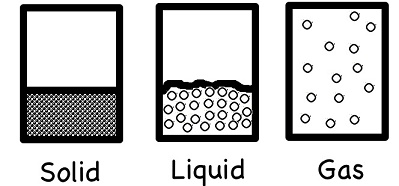
Thermal or heat energy can convert one state of matter into another state. Thus, a particular state of a matter depends on both intermolecular force and the thermal energy which basically depends upon temperature.
1. Solids
A piece of wood, a stone, a pencil, a pen, and a computer all are examples of solids. A solid has definite size and shape which do not change on their own. However, by using external forces you can change the shape of a solid. For example, you can cut a piece of metal into two and you can use hammer to change its shape.
In solids the constituent particles are present very close to each other and the intermolecular forces operating between the constituent particles are very strong and they are capable of keeping the molecules in fixed positions. This is the reason why solids are rigid and hard.
Also, solids cannot be compressed. The attractive intermolecular forces become repulsive when atoms or molecules are forced to come further closer. When a solid is heated there is an increase in thermal energy of the particles which results in conversion of solid into liquid. The temperature at which this happens is the melting point of the solid.
2. Liquids
Water is a liquid. Mustard oil and kerosene oil are other examples of liquids. A liquid has a definite volume. However, a liquid does not have a definite shape. It takes the shape of its container. A liquid can flow.
Liquids have properties intermediate between solids and gases. The intermolecular forces in liquids are weaker than solids but stronger than gases. In liquids the constituent particles do not occupy fixed position as in solids, but they have freedom of movement as in gases. In liquids intermolecular forces are stronger than those of gases. The constituent particles (atoms and molecules) in a liquid can break away from each other and get attracted while approaching the other molecules.
Like in solids, the intermolecular forces become repulsive when an attempt is made to bring the molecules closer by applying pressure. This is the reason why pressure does not have much effect on volume of liquids.
3. Gases
You cannot see gases but they are all around. You can feel the presence of air when the wind blows. The wind is moving air and is a mixture of many gases like oxygen, nitrogen, argon, carbon dioxide and others. A gas occupies the entire volume of the container irrespective of its size.
In gases, molecules move freely because the intermolecular forces are very weak and are unable to keep the gas molecules together in bulk. The molecules remain far apart from each other due to weak molecular interactions. Since molecules are far away from each other in gases, they can be brought closer when pressure is applied. This is the reason why-gases are highly compressible.
You can compress a gas only up to a certain limit. Beyond this limit repulsion between gas molecules becomes very high. Temperature also affects the volume of the gases. When temperature increases, volume of the gas also increases. For example when a closed container is heated it blasts due to rapid increase in volume.
Characteristics of States of Matter
| Solid | Liquid | Gas | |
| Volume | Fixed | Fixed | No Fixed |
| Density | High | Moderate | Low |
| Shape | Definite Shape | Shape of Container | No Definite Shape |
| Fluidity | Does not Flow | Flows Smoothly | Flows Smoothly |
| Cmpressibility | Negligible | Small | High |