Maths Chapter-12: Heron’s Formula
Why Heron’s Formula…?
When the triangle is a right angled triangle:
Area = \(\frac{1}{2}\times base\times altitude\)
Example:

Now, Area of \(\Delta ABC= \frac{1}{2}\times base\times altitude \)
\(Area\;of\;\Delta ABC= \frac{1}{2}\times 12\times 5 = 30\;cm^{2}\)
When the triangle is an equilateral triangle:
Consider an equilateral triangle ABC with each side = 10cm

If we drop AM perpendicular to BC then BM = 5cm,
Now, AB2 = AM2 + BM2 (Pythagoras Theorem)
AM2 = 102 – 52
Therefore, AM = \(5\sqrt{3}\) cm
Now, Area for triangle ABC = 2×(Area of triangle ABM)
And, \(Area\;\Delta ABM =\frac{1}{2}\times Base\times Altitude\)
Therefore, \(Area\;\Delta ABM =\frac{1}{2}\times 5\times 5\sqrt{3}\)
\(Area\;\Delta ABM =\frac{25\sqrt{3}}{2}\)cm2
Now, Area for triangle ABC = 2×(\(\frac{25\sqrt{3}}{2}\))cm2
Therefore, \(Area\; of \;\Delta ABC= 25\sqrt{3}\; cm^{2}\)
When the triangle is an isosceles triangle:
Consider an isosceles triangle ABC with equal sides AB = AC = 13 cm and unequal side BC = 10cm

Drop AM perpendicular to BC. Therefore CM = 5cm
Now, AC2 = AM2 + CM2 (Pythagoras Theorem)
AM2 = 132 – 52
Therefore AM = 12cm
Now, Area for triangle ABC = 2×(Area of triangle ACM)
And, \(Area\;\Delta ACM =\frac{1}{2}\times Base\times Altitude\)
Therefore, \(Area\;\Delta ACM =\frac{1}{2}\times 5\times 12\)
\(Area\;\Delta ABM \)= 30 cm2
Now, Area for triangle ABC = 2× 30 cm2
Therefore, Area of triangle ABC = 60cm2
When the triangle is a scalene triangle:
Suppose that we know the lengths of sides of a scalene triangle and we have to find its area. Now, for applying the above formula we need to calculate its height. But in this case we have no idea about how to calculate the height of a scalene triangle and that is why it’s very difficult to find its area. Thus, Heron gave a formula to find the area of any triangle known as Heron’s Formula.
Area of a Triangle \(ABC=\sqrt{s(s-a)(s-b)(s-c)}\)
where a, b and c are sides of the triangle.
s = semi perimeter (half of perimeter of triangle)
\(s=\frac{a+b+c}{2}\)
Finding square roots:
(i) Find values of: \(\sqrt{72895}\)

(ii)Find values of \(\sqrt{745}\)

Exercise – 12.1
Q.1: The lengths of two sides of a triangle ABC are 10cm and 7cm and its perimeter is 28cm. Find the area of a triangle ABC.
Sol.
Given perimeter = 28cm
Therefore, s = \(\frac{perimeter}{2}\) = 14cm
And a = 10cm, b =7cm and c = 11cm (Since, perimeter = a + b + c)
On applying Heron’s Formula;
\(Area\;of\;Triangle\;ABC=\sqrt{s(s-a)(s-b)(s-c)}\)
Therefore, area of Triangle ABC
=\(\sqrt{14(14-10)(14-7)(14-11)}\)
(or) =\(\sqrt{14\times 4\times 7\times 3}\)
= \(14\sqrt{6}\)
Therefore, area of triangle ABC = \(14\sqrt{6}\)cm2
Q.2: If perimeter of a triangular plot is 250m and the lengths of the sides of a triangular plot are in the ratio of 4 : 7 : 9. Find its area.
Sol.
Since, the lengths of the sides of a triangular plot are in the ratio of 4 : 7 : 9
Therefore, sides of triangular plot will be 4x, 7x and 9x

Given perimeter = 250m
Therefore, 4x + 7x + 9x = 250
Hence x = 12.5, that gives:
a = 4x = 50m, b = 7x = 87.5m and c = 9x = 112.5m
And s = \(\frac{perimeter}{2}\)= 125m
Now on applying Heron’s Formula;
\(Area\;of\;plot\;ABC=\sqrt{s(s-a)(s-b)(s-c)}\)
Therefore, area of plot ABC:
=\(\sqrt{125(125-50)(125-87.5)(125-112.5)}\)
(or) =\(\sqrt{125\times 75\times 37.5\times 12.5}\)
= \(937.5\sqrt{5}\)
=2096.3m2
Therefore, area of triangular plot ABC = 2096.3m2
Q.3: There is a triangular park in a locality having sides 110m, 90m and 40m. A gardener Fauzia has to plant grass inside. In how much area does she need to plant grass? Also Fauzia has to put a fence all around that triangular park. Find the cost of fencing that triangular park with barbed wire if the cost of barbed wire is Rs 25 per meter and also a space of 2m is to be left for a gate on any one side of that park.
Sol.
Given a = 110m, b = 90m and c = 40m
Therefore, perimeter = 110 + 90 + 40 = 240m
And s = \(\frac{perimeter}{2}\)= 120m

Now applying Heron’s Formula;
\(Area\;of\;park\;ABC=\sqrt{s(s-a)(s-b)(s-c)}\)
Therefore, area of park ABC:
=\(\sqrt{120(120-110)(120-90)(120-40)}\)
(or) =\(\sqrt{120\times 10\times 30\times 80}\)
= \(1200\sqrt{2}\)
= 1697.07m2 (Approx.)
Therefore, area of triangular plot ABC = 1697.07m2 (Approx.)
Since, perimeter = 240m
Therefore for fencing length of wire needed = 240 – 2 = 238m
So the total cost of fencing the triangular park = 238×25 = 5950Rs
Q.4: The side walls of a flyover are triangular in shape and are used for advertisements. Dimensions of side walls are: 120m, 140m and 50m. The cost of posting advertisements is 4500Rs per m2 per year. How much rent an automobile company paid if the company hired one of its walls for 4 months?
Sol.
Given a = 120m, b = 140m and c = 50m
Therefore, perimeter of each triangular wall = 120 + 140 + 50 = 310m
And s = \(\frac{perimeter}{2}\)= 155m
Now applying Heron’s Formula;
\(Area\;of\;triangle\;ABC=\sqrt{s(s-a)(s-b)(s-c)}\)
Therefore, area of each triangular wall:
=\(\sqrt{155(155-120)(155-140)(155-50)}\)
(or) =\(\sqrt{155\times 35\times 15\times 105}\)
= \(525\sqrt{31}\)
Therefore, area of each triangular wall = \(525\sqrt{31}\)m2
Since, rent of posting advertisements is 4500 per m2 per year (12 months)
Therefore rent for \(525\sqrt{31}\)m2 area = \(525\sqrt{31}\) × 4500
= \(2362500\sqrt{31}\)Rs per year(12 months).
Now, For 12 months’ rent = \(2362500\sqrt{31}\) Therefore for 4months = \(\frac{4\times 2362500\sqrt{31}}{12}=787500\sqrt{31}\)
Hence, rent paid by company for hiring one of its walls for 4 months = \(787500\sqrt{31}\)Rs.
Q.5: If each side of a triangle is increased by six times then find the total percentage of increase in its area.
Sol.
Let a, b and c be the sides of the original triangle. Then,
Perimeter of original triangle = a + b + c and s1 = \(\frac{a + b + c}{2}\)
And sides of the new triangle will be 6a, 6b and 6c. Then,
Perimeter of new triangle = 6a + 6b + 6c and s2 = \(\frac{6a + 6b + 6c}{2}\) = 3(a + b + c) = 6s1 (Since, 2s1 = a + b + c)
Let A1 and A2 be the areas of the original and new triangle respectively. Then,
Area of triangle A1=\(\sqrt{s_{1}(s_{1} – a)(s_{1} – b)(s_{1} – c)}\)
And Area of triangle A2=\(\sqrt{s_{2}(s_{2} – a)(s_{2} – b)(s_{2} – c)}\)
Since, s2 = 6s1
Therefore, Area of triangle A2=\(\sqrt{6s_{1}(6s_{1} – a)(6s_{1} – b)(6s_{1} – c)}\)
Area of triangle A2=\(\sqrt{12s_{1}(s_{1} – a)(s_{1} – b)(s_{1} – c)}\)
Therefore, A2 = 12A1
Therefore, increase in the area of triangle = A2 – A1
= 12A1 – A1 = 11A1
Therefore, percentage increase in area = \(\frac{11A_{1}}{A_{1}}\times 100\) = 1100%
Hence, area of the new triangle is increased by 1100%
Q.6: If perimeter of a triangular plot is 490 and the lengths of the sides of a triangular plot are in the ratio of 22 : 16 : 32. Find its area.
Sol.
Since, the lengths of the sides of a triangular plot are in the ratio of 22 : 16 : 32
Therefore, sides of triangular plot will be 22x, 16x and 32x

Given perimeter = 490m
Therefore, 22x + 16x + 32x = 490
Hence x =7 , that gives:
a =22x = 154m, b = 16x = 112m and c = 32x = 224m
Therefore perimeter = a + b + c = 490m
And s = \(\frac{perimeter}{2}\)= 245m
Now on applying Heron’s Formula;
\(Area\;of\;plot\;ABC=\sqrt{s(s-a)(s-b)(s-c)}\)
Therefore, area of plot ABC:
=\(\sqrt{245(245-154)(245-112)(245-224)}\)
(or) =\(\sqrt{245\times 91\times 133\times 21}\)
= 7891.13m2 (Approx.)
Therefore, area of triangular plot ABC = 7891.13 m2 (Approx.)
Q.7: The length of equal sides of an isosceles triangle ABC is 8cm and its perimeter is 28cm. Find the area of a triangle ABC.
Sol.
Given perimeter = 28cm
Therefore, s = \(\frac{perimeter}{2}\) = 14cm
And a = 8cm, b =8cm and c = 12m (Since, perimeter = a + b + c)
On applying Heron’s Formula;
\(Area\;of\;Triangle\;ABC=\sqrt{s(s-a)(s-b)(s-c)}\)
Therefore, area of Triangle ABC
=\(\sqrt{14(14-8)(14-8)(14-12)}\)
(or) =\(\sqrt{14\times 6\times 6\times 2}\)
= \(12\sqrt{7}\)
=31.75cm2 (Approx.)
Therefore, area of triangle ABC = 31.75cm2(Approx.)
Exercise – 12.2
Q.1 Ankesh grows rice in a triangular field with sides 260m, 180m and 350m. Adjacent to this field there is another field with sides 260m, 280m and 380m where he wants to grow carrot and ladyfinger. He decided to divide this field in to two parts by joining the mid-point of the longest side to the opposite vertex. Now in one part he will be growing carrot and in other part he will be growing lady finger. Find how much area (in hectare) is used for growing rice, carrot and ladyfinger.
Sol.
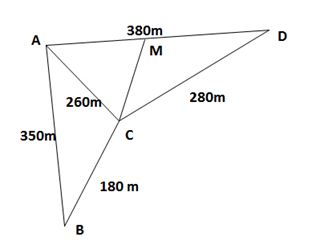
Consider triangle ABC,
Here a = 350m, b = 260m and c = 180m
Now, s = \(\frac{350 + 260 + 180}{2}\)
Therefore, s = 395
Now applying Heron’s Formula;
\(Area\;of\;triangle\;ABC=\sqrt{s(s-a)(s-b)(s-c)}\)
Therefore, area of triangle ABC :
=\(\sqrt{395(395-350)(395-260)(395-180)}\)
(or) =\(\sqrt{395\times 45\times 135\times 215}\)
= \(\sqrt{515919375}\)
Therefore, area of triangle ABC = 22713.86m2 (approx.)
Since 1 hectare = 10000 m2
Hence area used for growing rice = 2.27 hectares (approx.)
Consider triangle ACD,
Here a = 260m, b = 280m and c = 380m
Now, s = \(\frac{260 + 280 + 380}{2}\)
Therefore, s = 460
Now applying Heron’s Formula;
\(Area\;of\;triangle\;ACD=\sqrt{s(s – a)(s – b)(s – c)}\)
Therefore, area of triangle ACD:
=\(\sqrt{460(460-260)(460-280)(460-380)}\)
(or) =\(\sqrt{460\times 200\times 180\times 80}\)
= \(\sqrt{1324800000}\)
Therefore, area of triangle ABC = 36397.80m2 (approx.)
Since 1 hectare = 10000 m2
Hence area used for growing Carrot and ladyfinger = 3.63 hectares (approx.)
Since, M is the mid-point of AD and CM divides the triangle CAD in two halves equal in area. Therefore, area for growing carrot = area for growing ladyfinger = 1.815 hectares.
Q.2 A plot is in the shape of trapezium whose non parallel sides are 12m and 14m and parallel sides are 10m and 20m. Find the area of park.
Sol.

Here area of park = area of trapezium ABCD
Area of Trapezium = \(\frac{1}{2}\)× (AD + BC) × BM
BM =???
Draw BM perpendicular to AD and BN parallel to CD
Since BC is parallel to DN and BN is parallel to CD therefore, BCDN forms a parallelogram.
Therefore, BN = 12cm (opposite side of parallelogram)
AN = 10cm (20 – DN = 10cm) and
AB = 14cm (given)
Perimeter = (a + b + c) = 36m
Therefore s = \(\frac{perimeter}{2}\)= 18m
Now applying Heron’s Formula;
\(Area\;of\;triangle\;ABN=\sqrt{s(s-a)(s-b)(s-c)}\)
Therefore, area of triangle ABN:
=\(\sqrt{18(18-12)(18-14)(18-10)}\)
(or) =\(\sqrt{18\times 6\times 4\times 8}\)
= \(24\sqrt{6}\)m2
Therefore, area of triangle ABN = \(24\sqrt{6}\)m2
In triangle ABN, area of triangle ABC = \(\frac{1}{2}\)×base × altitude
Therefore \(24\sqrt{6}\) = \(\frac{1}{2}\)×10×BM
Therefore, 10 BM = 2×\(24\sqrt{6}\)
Therefore BM = \(\frac{24\sqrt{6}}{5}\)m
Now, area of Trapezium ABCD = \(\frac{1}{2}\)× (AD + BC) × BM
= \(\frac{1}{2}\)× (20 + 10) × \(\frac{24\sqrt{6}}{5}\)
= \(72\sqrt{6}\)m2
=176.36m2 (Approx.)
Therefore, area of park = area of trapezium ABCD = 176.36m2 (Approx.)
Q.3 Eight Triangular pieces of two different colours are stitched together to make an umbrella. Each piece measuring 10cm, 40cm and 40cm. Find how much cloth of each colour is used to make the umbrella.
Sol.

Consider triangle ABC:
Here a = 40cm, b = 40cm and c = 10cm
Therefore, perimeter = 40 + 40 +10 = 90cm
Hence s = \(\frac{perimeter}{2}\)= 45cm
Now applying Heron’s Formula;
\(Area\;of\;triangle\;ABC=\sqrt{s(s-a)(s-b)(s-c)}\)
Therefore, area of triangle ABC:
=\(\sqrt{45(45-40)(45-40)(45-10)}\)
(or) =\(\sqrt{45\times 5\times 5\times 35}\)
= \(75\sqrt{7}\)cm2
Therefore, area of triangle ABC = \(75\sqrt{7}\)cm2
Since there are 4 triangular pieces of two different colours each
Therefore, area of each clothes required:
=\(75\sqrt{7}\)×4
=\(300\sqrt{7}\)cm2
=793.73 cm2 (Approx.)
Q.4 There is a rhombus shaped field that has to be divided in to 5 sons. If each side of that field is 40m and its longer diagonal is 48m, how much area will each son be getting?
Sol.

Let ADCB be a rhombus shaped field.
In triangle ABC
Since, AB = BC = 40m and AC = 48m
Therefore perimeter = (40 + 40 + 48) = 128m
Hence s = \(\frac{perimeter}{2}\)= 64m
Now applying Heron’s Formula;
\(Area\;of\;triangle\;ABC=\sqrt{s(s-a)(s-b)(s-c)}\)
Therefore, area of triangle ABC:
=\(\sqrt{64(64-40)(64-40)(64-48)}\)
(or) =\(\sqrt{64\times 24\times 24\times 16}\)
= 768m2
Therefore, area of field = 2× area of triangle ABC
Therefore area of field = 1536m2
Since there are 4 sons, therefore each son will get 384m2 of field.
Q.5 Three Students of Saint Thomas School and three students of Saint Marry School participated in a cleanliness campaign. There were two groups of each school, 1st group was of Saint Thomas School and walked through the lanes PS, SR and RP and 2nd group was of Saint Marry School and walked through the lanes PQ, QR and RP. Then they cleaned the area enclosed within their lanes (As shown in figure). Find the total area cleaned in this campaign by the students of both school. Also find which school cleaned more area and by how much??

Sol.
Area cleaned by Saint Marry School = Area of triangle PQR
Since PQR is a right angled triangle
Therefore area of triangle PQR:
= \(\frac{1}{2}\times Base\times Altitude\)
=\(\frac{1}{2}\times 24\times 7\)
Therefore area of triangle PQR = 84m2
Hence area cleaned by Saint Marry School (A1) = 84m2
Area cleaned by Saint Thomas School = Area of triangle PRS
Since PR2 = RQ2 + PQ2 (Pythagoras Theorem)
PR2 = 72 + 242
Therefore, PR = 25 m
Now, In triangle PRS;
a = 20m, b = 9m and c = 25m
Therefore, Perimeter = a + b + c = 54m
Hence s = \(\frac{perimeter}{2}\)= 27m
Now applying Heron’s Formula;
\(Area\;of\;triangle\;PRS=\sqrt{s(s-a)(s-b)(s-c)}\)
Therefore, area of triangle PRS:
=\(\sqrt{27(27 – 20)(27 – 9)(27 – 25)}\)
(or) =\(\sqrt{27\times 7 \times 18 \times 2}\)
=\(18\sqrt{21}\)
= 82.486m2 (Approx.)
Therefore, Area cleaned by Saint Thomas School (A2) = 82.486m2 (Approx.)
So, total area cleaned = A1 + A2 = 84 + 82.48 = 166.48m2
Since, A1 > A2 and A1 – A2 = 1.52m2 (Approx.)
Therefore, area cleaned by students of Saint Marry School is greater than area cleaned by students of Saint Thomas School by 1.52m2 (Approx.)
Q.6 Find the total area of given figure.
Sol.

Area of figure-1:
Area DCMK represents a rectangle, with DC = 1cm and DK = 10cm
Therefore area of figure DCMK = length × breadth
= 1 × 10
Therefore area of figure-1 = 10cm2
Area of figure-4:
Triangle GKH represents a right angled triangle
From figure 4; base = 2cm and height = 8cm
Therefore area of triangle GKH
= \(\frac{1}{2}\times base\times altitude\)
=\(\frac{1}{2}\times 2\times 8\)
Therefore area of figure-4 = 8cm2
Since figure-4 and figure-5 are similar
Therefore area of figure-5 = 8cm2
Area of figure-3:
In triangle KLM; a = 5cm, b = 5cm and c = 1cm
Therefore, Perimeter = a + b + c = 11cm
Hence s = \(\frac{perimeter}{2}\)= 5.5cm
Now applying Heron’s Formula;
\(Area\;of\;triangle\;KLM=\sqrt{s(s-a)(s-b)(s-c)}\)
Therefore, area of triangle KLM:
=\(\sqrt{5.5(5.5 – 5)(5.5 – 5)(5.5 – 1)}\)
(or) =\(\sqrt{5.5\times 0.5\times 0.5\times 4.5}\)
= \(\frac{3\sqrt{11}}{4}\)cm2
Therefore, area of figure- 3 = 2.487cm2
Area of figure-2:
Figure ABCD represents a trapezium

From figure: In triangle AMD
AD = 8cm (given)
AM + NB = AB – MN = 1cm
Therefore, AM = 0.5cm
Now,
AD2 = AM2 + MD2
MD2= 12 – 0.52
MD = 0.866cm
Now, area of trapezium = \(\frac{1}{2}\times (base_{2}+base_{1})\times height\)
=\(\frac{1}{2}\times (2+1)\times 0.866\)
Hence, area of trapezium = 1.299cm2
Therefore, area of figure-2 = 1.299cm2
Hence, total area of given figure = figure-1 + figure-2 + figure-3 + figure-4 + figure-5
= 10 +1.299 + 2.487 + 8 + 8
Therefore, total area of given figure = 29.786cm2
Q.7: Find the Area of a quadrilateral PQRS in which PQ = 10cm, QR = 7cm, RS =9cm, PS = 8cm and SQ = 14cm
Sol.

Consider triangle PQS;
Here a = 10cm, b = 8cm and c = 14cm
Therefore Perimeter = 10 + 8 + 14 = 32cm
Hence s = \(\frac{perimeter}{2}\)= 16cm
Now applying Heron’s Formula;
\(Area\;of\;triangle\;PQS=\sqrt{s(s-a)(s-b)(s-c)}\)
Therefore, area of triangle PQS:
=\(\sqrt{16(16 – 10)(16 – 8)(16 – 14)}\)
(or) =\(\sqrt{16\times 6\times 8\times 2}\)
= \(16\sqrt{6}\)cm2
= 39.19cm2 (Approx.)
Therefore, area of triangle PQS = 39.19cm2 (Approx.)
Consider triangle QRS;
Here a = 7cm, b = 9cm and c = 14cm
Therefore Perimeter = 7 + 9 + 14 = 30cm
Hence s = \(\frac{perimeter}{2}\)= 15cm
Now applying Heron’s Formula;
Area of triangle QRS=\(\sqrt{s(s-a)(s-b)(s-c)}\)
Therefore, area of triangle QRS:
=\(\sqrt{15(15 – 7)(15-9)(15-14)}\)
(or) =\(\sqrt{15\times 8\times 6\times 1}\)
= \(12\sqrt{5}\)cm2
= 26.83 cm2 (Approx.)
Therefore, area of triangle QRS = 26.83cm2 (Approx.)
Now, area of quadrilateral = area of triangle PQS + area of triangle QRS
= 39.19+26.83 = 66.02cm2 (Approx.)
Therefore area of quadrilateral PQRS = 66.02cm2 (Approx.)
Q.8: A parallelogram and a triangle with sides 12cm, 15cm and 9cm have the same area and the same base. The Base of the triangle and the parallelogram is taken as 12cm. Find the height of the parallelogram.
Sol.

From triangle ABC;
Here a = 12cm, b = 9cm and c = 15cm
Therefore Perimeter = 12 + 9 + 15 = 36cm
Hence s = \(\frac{perimeter}{2}\)= 18cm
Now applying Heron’s Formula;
Area of triangle ABC=\(\sqrt{s(s-a)(s-b)(s-c)}\)
Therefore, area of triangle ABC:
=\(\sqrt{18(18 – 12)(18-9)(18-15)}\)
(or) =\(\sqrt{18\times 6\times 9\times 3}\)
= 54cm2
Therefore, area of triangle ABC = 54cm2
Area of parallelogram = area of triangle (Given)
Therefore 54 = base × height
Height = 4.5cm
Therefore height of parallelogram = 4.5cm