Maths Chapter-06: Triangles
Exercise 1
Question 1:
Fill in the blanks
A: All circles are ________ (Similar, Congruent)
Solution: All circles are similar.
B: All squares are ________ (Congruent, similar)
Solution: All squares are similar.
C: All _________ triangles are similar. (Isosceles, equilateral)
Solution: All equilateral triangles are similar.
D: Two polygons having the same number of sides are similar, if
(i) Their corresponding angles are _______ and
(ii) Their corresponding sides are __________. (Proportional, equal)
Solution: Two polygons having the same number of sides are similar, if (i) their corresponding angles are equal and (ii) their corresponding sides are proportional
Question 2:
Give examples for the following, two of each.
A: Similar figures
B: Non-similar figures
Solution:
A: Two ten dollar notes and two ten cent coins.
B: One 5 cent coin and 10 cent coin and one 5 dollar note and ten dollar note.
Question 3:
Find out whether the quadrilaterals that are given below are similar.

Solution:
Since, the corresponding angles of both the figures are not equal, the figures given are not similar.
Exercise 2
Question 1:
From the given figures , we get that ST ? QR. Find TR in (i) and PS in (ii).
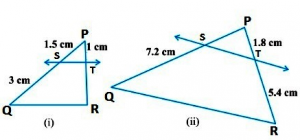
Solution:
In the triangle, PQR, ST ? QR (given)
Therefore, PS/SQ = PT/TR [Using the basic Proportionality theorem]
=> 1.5/3 = 1/ TR
=> ? TR = 3/1.5
TR = 3 x 10/15 = 2cm
Hence, TR = 2cm
(ii) In triangle PQR, ST ? QR (given)
Therefore, PS/ SQ = PT / TR [Using the basic proportionality theorem]
= > PS/7.2 = 1.8/5.4
= > PS = 1.8 x 7.2/5.4 = 18/10 x 72/10 x 10/54 = 24/10
= > PS = 2.4
Hence, PS = 2.4 cm
Question 2:
A and B are two points on the sides of XY and XZ respectively of a XYZ triangle. State whether AB ? YZ for the following given cases:
1: XA = 3.9 cm, AY = 3 cm XB = 3.6 cm and BZ= 2.4 cm
2: XA = 4 cm, YA = 4.5 cm, XB = 8 cm and ZB = 9 cm
3: XY = 1.28 cm, XZ = 2.56 cm, XA = 0.18 cm and XB = 0.63 cm

Solution:
In triangle XYZ, A and B are the two points on sides XY and XZ respectively.
1: XA = 3.9 cm and AY = 3 cm (given)
XB = 3.6 cm, BZ = 2.4 cm (Given)
Therefore, XA/AY = 3.9/3 = 39/30 = 13/10 = 1.3 [Using the basic proportionality theorem]
And, XB/BZ = 3.6/2.4 = 36/24 = 3/2 = 1.5
So, XA/AY ? XB/BZ
Hence, AB is not parallel to YZ.
2: XA = 4cm, YA = 4.5 cm, XB = 8cm, ZB= 9cm
Therefore, XA/YA = 4/4.5 = 40/45 = 8/9 [Using the basic proportionality theorem]
And, XB/ZB = 8/9
So, XA/YA = XB/ZB
Hence, AB is parallel to YZ
3: XZ = 1.28 cm, XZ = 2.56 cm, XA= 0.18 cm, XB= 0.36 cm (Given)
Here, AY = XY – XA = 1.28-0.18 = 1.10 cm
And, BZ = XZ – XB = 2.56 – 0.36 = 2.20 cm
So, XA/AY = 0.18/1.10 = 18/110 = 9/55 – – – – – – – – – – – – (1)
And, XA/BZ = 0.36/2.20 = 36/220 = 9/55 – – – – – – – – – – – (2)
Therefore, XA/AY = XB/BZ
Hence, AB is parallel to XY.
Question 3:
From the given figure, we see that AB ? RQ and AC ? RS, prove that PB/BQ = PC/PS
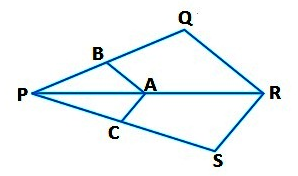
Solution:
From the given figure, we get AB ? RQ
By using the basic proportionality theorem, we get,
PB/BQ = PA/ PR – – – – – – – – (1)
Similarly, AC ? RS
Therefore, PC/PS = PA/PR – – – – (2)
From (1) and (2) we get,
PB/BQ = PC/PS
Question 4:
From the figure we get, ST ? PR and SU ? PT. Prove that QU/UT = QT/TR

Solution:
In triangle PQR, ST ? PR (Given)
Therefore, QS/SP= QT/TR – – – – – – – (1) [Using the proportionality Theorem]
In triangle PQR, SU ? PT (Given)
Therefore, QS/SP = QU/UT – – – – – – (2) [Using the basic proportionality theorem]
From equation (1) and (2) we get,
QT/TR = QU/UT
Question 5:
From the following figure we get, XZ ? AC and XZ ? AD, show that YZ ? CD.
Solution:
In triangle BCA, XY ? AC (Given)
Therefore, BX/XA = BY/YC – – – – – – – (1) [Using the basic proportionality theorem]
In triangle BCA, XY ? AC (Given)
Therefore, BX/XA = BZ/ZD – – – – – – – (2) [Using the basic proportionality theorem]
From the equation (1) and (2) we get,
BY/YC = BZ/ZD
In triangle BCA, YZ ? CD [By converse of the basic proportionality theorem]
Question 6:
From the figure, three points X, Y and Z are points on AB, AC and AD respectively such that XY ? BC and XZ ? BD. Show that YZ ? CD
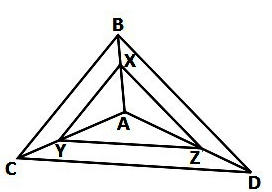
Solution:
In triangle ABC, XY ? BC (Given)
Therefore, AX/XB = AY/YC – – – – – – – (1) [Using the basic proportionality theorem]
In triangle ABC, XZ ? BD (Given)
Therefore, AX/XB = AZ/ ZD – – – – – – – (2) [Using the basic proportionality theorem]
From the equations (1) and (2), we get
AY/ YC = AZ/ZD
In triangle ACD, YZ ? CD [By the converse of basic proportionality theorem]
Question 7:
Using the basic proportionality theorem, prove that a line drawn through the midpoints of one side of a triangle is parallel to the other side that bisects the third side.
Solution:

From the given diagram we get,
The triangle PQR in which S is the midpoint of P and Q such that PS=SQ
A line parallel to QR intersects PR at T such that ST ? QR
To prove: T is the midpoint of PR
Proof: S is the midpoint of PQ
Therefore, PS=SQ
=>PS/QS = 1 – – – – – – – (1)
In triangle PQR, ST ? QR,
Therefore, PS/SQ = PT / TR [Using the basic proportionality theorem]
=>1 = PT/ TR [from equation (1)]
Therefore, PT = TR
Hence, T is the midpoint of PR
Question 8:
Prove that the line joining the midpoints of any two sides of a triangle is parallel to the third side by using the converse of basic proportionality theorem.
Solution:

Given:
From the triangle PQR in which ST are the midpoints of PQ and PR respectively such that PS = SQ and PT= TR
To prove: ST ? QR
Proof: S is the midpoint of PQ (Given)
Therefore, PS = SQ
=>PS/QS = 1 – – – – – – – – – (1)
Also, T is the midpoint of PR (Given)
Therefore, PT= TR
=>PT/TR = 1 [from equation (1)]
From equation (1) and (2) we get,
PS/ QS = PT/ TR
Hence, ST ? QR [By the converse of the basic proportionality theorem]
Question 9:
PQRS is a trapezium in which PQ ? SR and its diagonals intersect each other at a point A. show that PA/QA = RA/SA
Solution:

Given:
PQRS is a trapezium in which PQ ? RS in which the diagonals PR and QS intersect each other at A.
To prove: PA/QA = RA/ SA
Construction: Through A, draw TA ? SR ? PQ
Proof: In triangle PSR, we have
AT ? SR (By construction)
Therefore, PT/TS = PA/RA – – – – – – – (1) [Using the basic proportionality theorem]
In triangle PQS, we have
AT ? PQ (by construction)
Therefore, ST/TP = SA/QA – – – – – – – – – (2) [Using the basic proportionality theorem]
From the equations (1) and (2) we get,
PA/RA = QA / SA
=>PA / QA = RA/SA
Question 10:
The diagonals of a quadrilateral PQRS intersect each other at the point A such that PA/QA = RA/SA. Show that PQRS is a trapezium.

Solution:
Given:
Quadrilateral PQRS in which diagonals PR and QS intersect each other at A such that PA/ QA = RA/SA
To prove: PQRS is a trapezium
Construction: Through A, draw line TA, where TA ? PQ, which meets PS at T
Proof: In triangle SPQ, we have
TA ? PQ
Therefore, ST/TP = SA/AQ – – – – – – (1) [Using the basic proportionality theorem]
Also, PA/QA = RA/SA (Given)
=>PA/ RA = QA/ SA
=> RA/PA = QA/SA
=> SA/AQ = RA/PA – – – – – – – – (2)
From the equations (1) and (2) we get,
ST / TP = RA/ PA
Therefore, By using converse of Basic proportionality theorem,
TA ? SR also TA ? PQ
=>PQ ? SR
Hence, quadrilateral PQRS is a trapezium with PQ ? RS
Exercise 3
Question 1:
Which of the following triangle pairs are similar? State the similarity criterion you used to determine the similarity of the triangles.

Solution:
(i)For ?ABC and ?PQR:
?A=?P = 60o (Given)
?B =?Q = 80o(Given)
?C =?R = 40o(given)
? ? ABC ~ ?PQR (AAA similarity criteria)
(ii)For ?JKL and ?ZXC
JK/XC = KL/CZ = JL/XZ
? ?JKL~ ?ZXC (SSS similarity criterion)
(iii) For ?JKL and ?ZXC:
JK = 2.7, KL = 2, LJ = 3, ZX = 5, XC = 4, CZ = 6
KL/ZX = 2/4 = 1/2
JL/ZC = 3/6 = 1/2
JK/XC= 2.7/5 = 27/50
Here, KL/ZX = LJ/ZC ? JK/XC
Thus, ?JKL and ?ZXC are not similar.
(iv) For ?JKL and ?ZXC
JK = 2.5, KL = 3, ?J = 80°, XC = 6, ZC = 5, ?C = 80°
Here, JK/ZC = 2.5/5 = 1/2
And, KL/XC = 3/6 = 1/2
? ?K ? ?C
Thus, ?JKL and ?ZXC are not similar.
(v) For ?JKL, we have
?J + ?K + ?L = 180° (sum of angles of a triangle)
? 70° + 80° + ?L = 180°
? ?L = 180° – 70° – 80°
? ?L = 30°
In ZXC, we have
?Z + ?X + ?C = 180 (Sum of angles of ?)
? ?Z + 80° + 30° = 180°
? ?Z = 180° – 80° -30°
? ?Z = 70°
In ?JKL and ?ZXC, we have
?J = ?Z = 70°
?K = ?X = 80°
?L = ?C = 30°
Thus, ?JKL ~ ?ZXC (AAA similarity criterion)
Question 2:
In the figure below, ?JKL ? ¼ ?ZXL, ?KJL=70O and ?ZLX = 70O. Find ?JLK, ?JKL AND ?LZX

Solution:
JLX is a straight line.
Thus, ?JLK + ? KLX = 180°
? ?JLK = 180° – 125°
= 55°
In ?JLK,
?JKL+ ? KJL + ? JLK = 180°
(Sum of the measures of the angles of a triangle is 180º.)
? ?JKL + 70º + 55º = 180°
? ?JKL = 55°
Given that ?LJK ~ ?LXZ.
? ?LZX = ?LKJ (Corresponding angles are equal in similar triangles)
? ? LZX = 55°
? ?LZX= ?LKJ (Corresponding angles are equal in similar triangles)
? ?LZX= 55°
Question 3:
Diagonals JX and KZ of a trapezium JKZX with JK || ZX intersect each other at the point L. With the help of similarity criterion for two triangles, prove that JL/LX = KL/KZ.

Solution:
In ?ZLX and ?JLK,
?XZL = ?JKL (Alternate interior angles as JK || XZ)
?ZXL = ?KJL (Alternate interior angles as JK || XZ)
?ZLX = ?KLJ (Vertically opposite angles)
? ?ZLX ~ ?KLJ (AAA similarity criterion)
? ZL/KL = LX/LJ (Corresponding sides are proportional)
? LJ/LX = LK/LZ
Question 4:
In the given figure, LX/LZ = LJ/KX and ?1 = ?2. Prove that ?KXZ ~ ?JLX.

Solution:
In ?JLX, ?KLX = ?KXL
? KL = KX … (i)
Given, LX /LZ = LJ/KX
Using (i), we get
LX/LZ = LJ/LK ..(ii)
In ?KLZ and ?JLX,
LX/LZ = LJ/LK (using(ii))
?L = ?L
? ?KZX ~ ?JLX [SAS similarity criterion]
Question 5:
In the given figure, K and L are points on sides JZ and JX of ?ZXJ such that ?Z = ?JLK. Prove that ?JZX ~ ?JLK.

Solution:
In ?JZX and ?JKL,
?JLK = ?XZK (Given)
?J = ?J (Common angle)
? ?JZX ~ ?JLK (By AA similarity criterion)
Question 6:
In the figure given, if ?JZL ? ?JXK, prove that ?JKL ~ ?JZX.

Solution:
Given, that ?JZL ? ?JXK.
? JZ = JX [By cpct] … (i)
Also, JK = JL [By cpct] … (ii)
In ?JKL and ?JZX,
JK/JZ = JL/JX [Dividing equation (ii) by (i)]
?J = ?J [Common angle]
? ?JKL ~ ?JZX [By SAS similarity criterion]
Question 7:
In the figure given below, lines ZK and JX of ?JZC intersect each other at the point L. Prove that:
(i) ?ZXL ~ ?JKL
(ii) ?ZCK ~ ?JCX
(iii) ?ZXL ~ ?ZKC
(iv) ?LKJ ~ ?CXJ

Solution:
(i) In ?ZXL and ?JKL,
?ZXL = ?JKL (Each 90°)
?ZLX = ?JLK (Vertically opposite angles)
Thus, by using AA similarity criterion,
?ZXL ~ ?JKL
(ii) In ?ZCK and ?JCX,
?ZKC = ?JXC (Each 90°)
?ZCK = ?JCX (Common)
Hence, by using AA similarity criterion,
?ZCK ~ ?JCX
(iii) In ?ZXL and ?ZKC,
?ZXL = ?ZKC (Each 90°)
?LZX = ?KZC (Common)
Hence, by using AA similarity criterion,
?ZXL ~ ?ZKC
(iv) In ?LKJ and ?CXJ,
?LKJ = ?CXJ (Each 90°)
?LJK = ?CJX (Common angle)
Hence, by using AA similarity criterion,
?LJK ~ ?CXJ
Question 8:
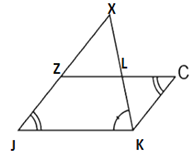
In the given figure X is a point on the side JZ of a parallelogram JKCZ and KX intersect ZC at L. Prove that ?JKX ~ ?CLK.
Solution:
In ?JKX and ?CLX,
?J = ?C (Opposite angles of a parallelogram)
?JXK = ?CKL (Alternate interior angles as JX || KC)
? ?JKX ~ ?CLX (By AA similarity criterion)
Question 9:
In the given figure, JKC and AMP are two right triangles, right angled at B and M respectively, show that:
i) ?JZC ~ ?JKX
(ii) CJ/XJ = ZC/KX
Solution:
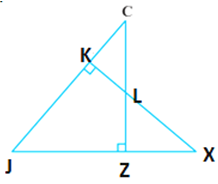
(i) In ?JZC and ?JKX, we have
?J= ?J (common angle)
?JZC = ?JKX = 90° (each 90°)
? ?JZC ~ ?JKX (By AA similarity criterion)
(ii) Since, ?ABC ~ ?AMP (By AA similarity criterion)
If two triangles are similar then the corresponding sides are equal,
Hence, CJ/XJ = ZC/KX
Question 10:
In the given figure CD and KH are the bisectors of ?ZCX and ?JKL respectively, such that D and H lie on sides ZX and JL of ?ZXC and ?JKL respectively. If ?ZXC ~ ?JKL. Prove that:
(i) CD/KH = ZC/JK
(ii) ?CXD ~ ?KLH
(iii) ?DZC ~ ?HKJ

Solution:
(i) Given that ?ZXC ~ ?JKL
? ?Z = ?J, ?X = ?L, and ?ZCX = ?JKL
?ZCX = ?JKL
? ?ZCD = ?JGH (Angle bisector)
And, ?DCX = ?HKL (Angle bisector)
In ?DZC and ?JKH,
?Z = ?J (Proved above)
?DCZ = ?JKH (Proved above)
? ?DZC ~ ?JKH (By AA similarity criterion)
? CD/KH = ZC/JK
(ii) In ?XCD and ?HKL,
?XCD = ?HK; (Proved above)
?X = ?L (Proved above)
? ?XCD ~ ?HKL (By AA similarity criterion)
(iii) In ?ZCD and ?HJK
?DCZ = ?JKH (Proved above)
?Z = ?J (Proved above)
? ?ZCD ~ ?HJK (By AA similarity criterion)
Question 11:
In the following figure, K is a point on side CL of an isosceles triangle JCL, where JL= JC. If JZ ? LC and KF ? CJ. Show that ?JLZ ~ ?FCK.

Solution:
It is given that JLC is an isosceles triangle.
? JL = JC
? ?JLZ = ?FCJ
In ?JLZ and ?FKC,
?JDL = ?CFK (Each 90°)
?LJZ = ?FKC (Proved above)
? ?JLZ ~ ?FCK (By using AA similarity criterion)
Question 12:
In the given figure sides ZX and XC and median ZV of a triangle ZXC are proportional to sides HJ and JL and median HK of ?PQR, respectively. Prove that ?ZCX ~ ?HJL.

Solution:
It is given that:
?ZCX and ?HJL, ZX, CX and median ZV of ?ZCX are proportional to sides HJ, JL and median HK of ?HJL
Or, ZX/HJ = CX/JL= ZV/
To Prove: ?ZCX ~ ?HJL
Proof: ZX/HJ = CX/JL = ZV/HK
? ZX/HJ = CX/JL = ZV/HK (V is the mid-point of CX and K is the midpoint of JL)
? ?ZXV ~ ?HJK [SSS similarity criterion]
? ?ZXV = ?HJK [Corresponding angles of two similar triangles are equal]
? ?ZXC = ?HJL
In ?ABC and ?PQR
ZX/HJ = CX/JL ….(i)
?CXZ = ?HJL….. (ii)
Hence, from equation (i) and (ii), we get
?CXZ ~ ?HJL [By SAS similarity criterion]
Question 13:
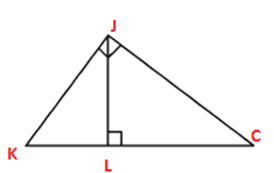
J is a point on the side CK of a triangle CJK such that ?JLC = ?KJC. Prove that CJ2 = CK.LC
Solution:
In ?CJL and ?JKC,
?CLJ = ?CJK (Given)
?JCL = ?KCJ (Common angle)
? ?CJL ~ ?JKC (By AA similarity criterion)
We know that corresponding sides of similar triangles are in proportion.
? CJ/KC =CL/JC
? CJ2 = CK.LC.
Question 14:
In the given figure, sides ZX and ZC and median ZV of a triangle CXZ are proportional to sides JK and JH and median JL of another triangle JKH, respectively. Show that ?CXZ~ ?JKH

Solution:
It is given that:
Two triangles ?CXZ and ?JKH in which ZV and JL are medians such that ZX/JK = CZ/JH = ZV/JL
To Prove: ?ZXC ~ ?JKH
Construction: Produce ZV to F such that ZV = VF. Connect CF. Similarly produce JL to N so that JL = LN, also connect HN.
Proof:
In ?ZXV and ?VCF, we have
ZV = VF [By Construction]
XV = VC [? AP is the median]
And, ?ZVX = ?CVF [Vertically opp. angles]
? ?ZXV ? ?CVF [By SAS criterion of congruence]
? ZX = CF [CPCT] ….. (i)
Also, in ?JKL and ?LNH, we have
JL = LN [By Construction]
KL = LH [? PM is the median]
and, ?JLK = ?NLH [Vertically opposite angles]
? ?JKL = ?LHN [By SAS criterion of congruence]
? JK = HN [CPCT] …. (ii)
Now, ZX/JK = ZC/JH = ZV/JL
? CF/HN = ZC/JH = ZV/JL … [From (i) and (ii)]
? CF/HN = ZC/JH = 2ZV/2JL
? CF/HN = ZC/JH = ZF/JN [? 2AD = AE and 2PM = PN]
? ?ZCF ~ ?JHN [By SSS similarity criterion]
Therefore, ?2 = ?4
Similarly, ?1 = ?3
? ?1 + ?2 = ?3 + ?4
? ?Z = ?J … (iii)
Now, In ?ZXC and ?JKH, we have
ZX/JK = ZC/JH (Given)
?Z = ?J [From (iii)]
? ?ZXC ~ ?JKH [By SAS similarity criterion]
Question 15:
A vertical pole of a length 6 m casts a shadow 4m long on the ground and at the same time, a tower casts a shadow 28 m long. Find the height of the tower.

Solution:
Length of the vertical pole = 6m (Given)
Shadow of the pole = 4 m (Given)
Let Height of tower = h m
Length of shadow of the tower = 28 m (Given)
In ?ZXC and ?JKL,
?C = ?K (angular elevation of sum)
?X = ?L = 90°
? ?ZXC ~ ?JKL (By AA similarity criterion)
? ZX/JL = XC/KL (when two triangles are similar corresponding sides are proportional)
? 6/h = 4/28
? h = 6×28/4
? h = 6 × 7
? h = 42 m
Therefore, the height of the tower is 42 m.
Question 16:
In the given figure if ZV and JM are medians of triangles ZXC and JKL, respectively. Where ?ZXC ~ ?JKL prove that ZX/JK = ZV/JM.

Solution:
It is given that: ?ZXC ~ ?JKL
We know that, the corresponding sides of similar triangles are in proportion
.? ZX/JK = ZC/JL = KC/KL … (i)
Also, ? Z= ?J, ?X = ?K, ?C = ?L …(ii)
As ZV and JM are medians, their opposite sides will be divided by them
.? XV = XC/2 and KM = KL/2 …(iii)
From equations (i) and (iii), we have
ZX/JK = XV/KM …(iv)
In ?ZXV and ?JKM,
?X = ?K [Using equation (ii)]
ZX/JK = XV/KM [Using equation (iv)]
? ?ZXV ~ ?JKM (By SAS similarity criterion)
? ZX/JK = XV/KM = ZV/JL.
Exercise 4
Question 1:
Let ? PQR ~ ? STU and their areas be, 64cm2 and 121cm2 respectively. If TU = 15.4, then find QR.
Solution:
Given,
The area of a triangle PQR = 64 cm2
The area of a triangle STU = 121 cm2
TU = 15.4 cm
And ? PQR ~ ? STU
Therefore, area of triangle PQR/ Area of triangle STU = PQ2 / ST2
= PR2 / SU2 = QR2 / TU2 – – – – – – – – – – (1)
[If the two triangles are similar then the ratio of their areas are said to be equal to the square of the ratio of their corresponding sides]
Therefore, 64 / 121 = QR2 / TU2
=> (8/11)2 = (QR/15.4)2
=> 8/11 = QR / 15.4
=> QR = 8 x 15.4 / 11
=> QR = 8 x 1.4
QR = 11.2 cm
Question 2:
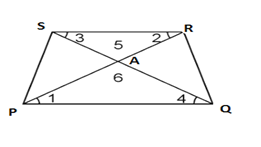
Diagonals of a trapezium PQRS with PR ? SR intersect each other at the point A. If PQ = 2RS, then find the ratio of the areas of the triangles PAQ and RAS.
Solution:
PQRS is a trapezium having PQ ? SR. The diagonals PR and QS intersect each other at a point A.
In ? PAQ and ? RAS, we have
\(\angle 1 = \angle 2(Alternate\:\, angles)\) \(\angle 3=\angle 4\, (Alternate\, angles)\) \(\angle 5=\angle 6\, (Vertically\, opposite\, angle)\)
Therefore, ? PAQ ~ ? RAS [By AAA similarity criterion]
Now, Area of (?PAQ) / Area of (?RAS)
= PQ2 / RS2 [If two triangles are similar then the ratio of their areas are equal to the square of the ratio of their corresponding sides]
= (2RS)2 / RS2 [Therefore, PQ=RS]
Therefore, Area of (? PAQ)/ Area of (?RAS)
= 4RS2/ RS = 4/1
Hence, the required ratio of the area of ?PAQ and ?RAS = 4:1
Question 3:
From the given figure, PQR and SQR are two triangles on the same base QR. If PS intersects QR at A, show that the area of triangle PQR / Area of triangle SQR = PA. SA
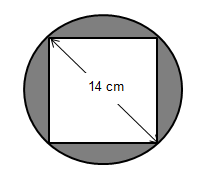
Solution:

Given,
PQR and SQR are the triangles in which have the same base QR. PS intersects QR at A.
To prove: Area of triangle PQR/ Area of triangle SQR = PA/ SA
Construction: Let us draw two perpendiculars PY and SX on line QR.
Proof:
We know that the area of a triangle = ½ x base x Height
Therefore, \(\frac{area\Delta PQR}{area\Delta SQR}\) = \(\frac{\frac{1}{2}QR\times PY}{\frac{1}{2}QR\times SX}\)
In ? PYA and ? SXA,
\(\angle PYA=\angle SXA(Each\, equals\, to\, 90^{\circ})\) \(\angle PAY= \angle SAX(Vertically\, opposite\, angles)\)
\(? \Delta PYA\sim \Delta SXA(By\, AA\, similarity\, criterion\, ? \frac{PY}{SX})\) = \(\frac{PA}{SA}\)
=> area of triangle PQR/ area of triangle SQR
=> PA/SA
Question 4:
If the areas of two triangles are similar and equal then, prove that they are congruent.

Solution:
Given:
? MNO and ? XYZ are similar and equal in area.
To prove that: ? MNO \(\cong\) ? XYZ
Proof: Since, ? MNO ~ ? XYZ
Therefore, Area of (? MNO) / Area of (? XYZ) = NO2/ YZ2
=> NO2 / YZ2 = 1 [Since the area of triangle MNO = area of triangle XYZ]
=> NO2 / YZ2
=> NO / YZ
Similarly, we can prove that
MN = XY and MO = XZ
Thus, ? MNO \(\cong\) ?XYZ [ By SSS criterion of congruence]
Question 5:
X , Y and Z are respectively the mid-points of sides PQ, QR and RP of ?PQR. Find the ratio of the areas of ?XYZ and ?PQR.

Solution:
Given:
X, Y and Z are the mid-points of sides PQ, QR and RA respectively from the ?PQR.
To Find: area(?XYZ) and area(?PQR)
Solution: In ? PQR, we have
Z is the midpoint of PQ (Given)
Y is the midpoint of PR (Given)
So, by the mid-point theorem, we have
ZY || RQ and ZY = ½ RQ
? ZY || RQ and ZY || QX [QX = ½ QR]
? QXYZ is parallelogram [Opposite sides of parallelogram are equal and parallel]
Similarly, in ? ZQX and ? XYZ, we have
ZQ = XY (Opposite sides of parallelogram QXYZ)
ZX = ZX (Common)
QX = ZY (Opposite sides of parallelogram QXYZ)
? ? ZQX ? ?XYZ
Similarly, we can prove that
? PZY ? ? XYZ
? YXR ? ? XYZ
If triangles are congruent, then they are equal in area.
So, area(? FBD) = area(? DEF) …(i)
area(? AFE) = area(? DEF) …(ii)
and, area(? EDC) = area(? DEF) …(iii)
Now, area(? ABC) = area(? FBD) + area(? DEF) + area(? AFE) + area(? EDC) …(iv)
area(? ABC) = area(? DEF) + area(? DEF) + area(? DEF) + area(? DEF)
? area(? DEF) = 1/4area(? ABC) [From (i), (ii) and (iii)]
? area(? DEF)/area(? ABC) = 1/4
Hence, area(? DEF):area(? ABC) = 1:4
Question 6:
Prove that the ratio of the areas of two similar triangles is equal to the square of the ratio of their corresponding medians.

Solution:
Given:
PA and XB are the medians of triangles PQR and XYZ respectively and ? PQR ~ ? XYZ
To prove: Area (? PQR)/ Area (? XYZ) = PA2 / XB2
Proof: ? PQR ~ ? XYZ (Given)
Therefore, Area (? PQR) / area (? XYZ ) = ( PQ2 / XY2) – – – – – – (1)
And, PQ / XY = QR / YZ = RP / ZX – – – – – (2)
\(\frac{PQ}{XY}=\frac{\frac{1}{2}QR}{\frac{1}{2}YZ}=\frac{RX}{ZX}\)
In ? PQA and ? XYB, we have
Therefore, \(\angle Q= \angle Y (Since\, \Delta PQR\sim \Delta XYZ)\)
PQ / XY = QA / YB [Prove in (1)]
Therefore, ? PQR ~ ? XYZ [By SAS similarity criterion]
=> PQ/XY = PA/ XB – – – – – – – (3)
Therefore, ? PQA ~ ? XYB
The areas of two similar triangles are proportional to the squares of the corresponding sides.
Therefore, Area of triangle PQR / Area of triangle XYZ = PQ2 / XY2 = PA2/ XB2
Question 7:
Prove that the area of an equilateral triangle described on one side of a square is equal to half the area of the equilateral triangle described on one of its diagonals.

Solution:
Given;
PQRS is a square whose one diagonal is PR. ? PXR and ? QYR are two equilateral triangles described on the diagonals PR and side QR of the square PQRS.
To prove:
Area of ? QYR = ½ Area of ? PXR
Proof:
? PXR and ? QYR are both equilateral triangles (Given)
Therefore, ? PXQ ~ ? QYR [AAA similarity criterion]
Therefore, Area of ? PXR / Area of ? QYR = PR2 / QR2
\((\frac{\sqrt{2}QR}{QR})^{2}=\frac{2QR^{2}}{QR^{2}}=2[Since,\, Diagonal=\sqrt{2}side=\sqrt{2}QR]\)
=> Area (? PXR) = 2 x area (? QYR)
=> area (? QYR) = ½ area (?PXR)
Question 8:
Tick the correct solutions and explain.
PQR and QST are two equilateral triangles such that S is the midpoint of QR. The ratio of the areas of triangles PQR and QST is:
(i) 2 : 1
(ii) 1 : 2
(iii) 4 : 1
(iv) 1 : 4
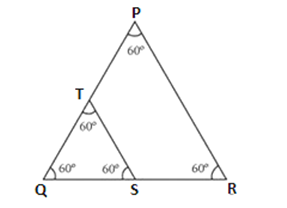
Solution:
? PQR and ? QST are two equilateral triangle. S is the midpoint of QR.
Therefore, QS = SR = ½ QR
Let each side of triangle be 2a
As, ? PQR ~ ? QST
Therefore, area (? PQR ) / area (? QST) = PQ2 / QS2 = (2a)2 / (a)2 = 4a2 / a2 = 4/1 = 4:1
Hence, The correct option is (iii)
Question 9:
Sides of two similar triangles are in the ratio 4 : 9. Areas of these triangles are in the ratio
(i) 2 : 3
(ii) 4: 9
(iii) 81 : 16
(iv) 16 : 81

Solution:
PQR and XYZ are two similarity triangles ? PQR ~ ? XYZ (Given)
And, PQ / XY = PR / XZ = QR / YZ = 4/9 (Given)
Therefore, Area of ?PQR / Area of ? XYZ = PQ2 / XY 2 [the ratio of the areas of these triangles will be equal to the squares of the ratio of the corresponding sides]
Therefore, Area of ? PQR / Area of ? XYZ = (4/9)2 = 16/81
=> 16:81
Hence, the correct option is (iv)
Exercise 5
Question 1:
Sides of the triangles are as follows:
- i) 7 cm, 25 cm, 24 cm
- ii) 3 cm, 6 cm, 8 cm
iii) 50 cm, 100 cm, 80 cm
- iv) 5 cm, 12 cm, 13 cm
Determine which of them are right-angled triangles. Write the length of its hypotenuse.
Solution:
- i) Sides of the triangle given are 7 cm, 25 cm and 24 cm.
Squaring the length of these sides we get 49 cm, 625 cm and 576 cm.
However, 49 + 576 = 625
(7)2 + (24)2 = (25)2
It satisfies the Pythagoras theorem. Hence, it is a right-angled triangle.
Length of Hypotenuse = 25 cm.
- ii) Sides of the triangle given are 3 cm, 6 cm and 8 cm.
Squaring the length of these sides we get 9 cm, 36 cm and 64 cm.
However, 9 + 36 ? 64
(7)2 + (24)2 ? (25)2
It does not satisfy the Pythagoras theorem. Hence, it is not a right-angled triangle.
iii) Sides of the triangle given are 50 cm, 100 cm and 80 cm.
Squaring the length of these sides we get 2500 cm, 10000 cm and 6400 cm.
However, 2500 + 6400 ? 10000
(50)2 + (80)2 ? (100)2
It does not the Pythagoras theorem. Hence, it is not a right-angled triangle.
- iv) Sides of the triangle given are 5 cm, 12 cm and 13 cm.
Squaring the length of these sides we get 25 cm, 144 cm and 169 cm.
However, 25 + 144 = 169
(5)2 + (12)2 = (13)2
It satisfies the Pythagoras theorem. Hence, it is a right-angled triangle.
Length of Hypotenuse = 13 cm.
Question 2:
ABC is a right-angled triangle at point A. P is a point on BC such that AP ? BC. Prove that AP2 = BP x PC.

Solution:
Given: ?ABC is a right-angled triangle at point A. P is appointed on BC such that AP ? BC.
To prove: AP2 = BP x PC
Proof:
In ?ABC, we have
AB2 = AP2 + BP2 [By Pythagoras theorem]
Or, AP2 = AB2 – BP2 ……….. (i)
In ?APC, we have
AC2 = AP2 + PC2 [By Pythagoras theorem]
Or, AP2 = AC2 – PC2 ……….. (ii)
Adding (i) and (ii), we get
2AP2 = (AB2 – BP2) – (AC2 – PC2)
= BC2 – BP2 – PC2 [ BC2 = AB2 + AC2]
= (BP + PC)2 – BP2 – PC2
= 2BP x PC
? AP2 = BP x PC
Question 3:
In the given figure, PQM is a right-angled triangle at P. Also PR ? QM.
Show that
i) PQ2 = QR x QM
ii) PR2 = QR x MR

Solution:
i) In ?PMQ and ?RPQ, we have
?MPQ = ?PRQ = 90o
?PQM = ?RQP (Common angle)
??PMQ ~ ?RPQ [AA similarity criterion]
? PQ/RQ = QM/PQ
? PQ2 = QR x QM
ii) Let ?RPQ = x
In ?RQP,
?RQP = 180o – 90o – x
?RQP = 90o – x
Similarly, in ?RPM
?RPM = 90o – ?RQP
= 90o – x
?RMP = 180o – 90o – (90o – x)
?RMP = x
In ?RQP and ?RPM, we have
?RQP = ?RPM
?RPQ = ?RMP
?PRQ = ?MRP = 90o
? ?RQP ~ ?RPM [By AAA similarity criterion]
?PR/MR = QR/PR
?PR2 = QR x MR
Question 4:
PQR is an isosceles right-angled triangle at point R. Prove that PQ2 = 2PR2.
Solution:

Given: ?PQR is an isosceles triangle right angled at R.
In ?PRQ, ?R = 90o
PR = QR (Given)
PQ2 = PR2 +QR2 [By Pythagoras theorem]
= PR2 + PR2 [Since, PR = QR]
PQ2 = 2PR2
Question 5:
PQR is an isosceles triangle with PR = QR. Given that PQ2 = 2PR2. Prove that PQR is a right-angled triangle.
Solution:

Given that ?PQR is an isosceles triangle having PR = QR and PQ2 = 2PR2
In ?PRQ,
PR = QR (Given)
PQ2 = 2PR2 (Given)
= PR2 + PR2
= PR2 + QR2 [Since, PR = QR]
Hence, by Pythagoras theorem ?PQR is a right-angle triangle.
Question 6:
PQR is an equilateral triangle of side 2a. Find each of its altitudes.
Solution:

Given: PQR is an equilateral triangle of side 2a.
Draw PS ? QR
In ?PSQ and ?PSR, we have
PQ = PR [Given]
PS = PS [Given]
?PSQ = ?PSR = 90o
Therefore, ?PSQ ? ?PSR by RHS congruence.
In right-angled ?PSQ,
(PQ)2 = (PS)2 + (QD)2
(2a)2 = (PS)2 + a2
? (PS)2 = 4a2 – a2
? (PS)2 = 3a2
? PS = \(\sqrt{3}a\)
Question 7:
Sum of the squares of the sides of a rhombus is equal to the sum of the squares of its diagonals. Prove it.
Solution:
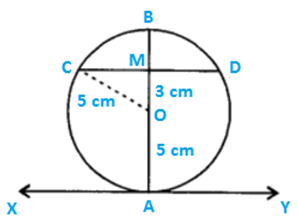
Given: PQRS is a rhombus whose diagonals are PR and QS. They intersect at O.
To prove: PQ2 + QR2 + RS2+ PS2 = PR2 + QS2
Since the diagonals of as rhombus bisect each other ar tight angles.
Therefore, PO = RO and QO = SO
In ?POQ,
?POQ = 90o
PQ2 = PO2 + QO2 ……. (i) [By Pythagoras]
Similarly,
PS2 = PO2 + SO2 ……. (ii)
RS2 = SO2 + RO2 ……. (iii)
QR2 = RO2 + QO2 ……. (iv)
Adding equation (i) + (ii) + (iii) + (iv) we get,
PQ2 + PS2 + RS2 + QR2 = 2(PO2 + QO2+ RO2 + SO2)
= 4PO2 + 4QO2 [Since, PO = RO and QO = SO]
= (2PO)2 + (2QO2) = PR2 + QS2
Question 8:
In the given figure, O is a point in the interior of a triangle PQR.

OS ? QR, OT ? PR and OU ? PQ. Show that
i) OP2 + OQ2 + OR2 – OS2 – OT2 – OU2 = PU2 + QS2 + RT2
ii) PU2 + QS2 + RT2 = PT2 + RS2 + QU2
Solution:
Join OP, OQ and OR
i) Applying Pythagoras theorem in ?POU, we have
OP2 = OU2 + PU2
Similarly, in ?QOS
OQ2 = OS2 + QS2
Similarly, in ?ROT
OR2 = OT2 + TR2
Adding these equations,
OP2 + OQ2 + OR2 = OU2 + PU2 + OS2 + QS2 + OT2 + RT2
OP2 + OQ2 + OR2 – OS2 – OT2 – OU2 = PU2 + QS2 + RT2.
ii) PU2 + QS2 + RT2 = (OP2 – OT2) + (OR2 – OS2) + (OQ2 – OU2)
\(?\) PU2 + QS2 + RT2 = PT2 + RS2 + QU2.
Question 9:
A ladder of 10 m length reaches a window of 8m above the ground. Find the distance of the foot of the ladder from the base of the wall.
Solution:

Let QP be the wall and PR be the ladder,
Therefore, by Pythagoras theorem, we have
PR2 = PQ2 + QR2
102 = 82 + QR2
QR2 = 100 -64
QR2 = 36
QR = 6 m
Therefore, the distance of the foot of the ladder from the base of the wall is 6 m.
Question 10:
An airplane leaves an airport and flies due north at a speed of 1,000 km/hr. At the same time, another airplane leaves the same airport and flies due west at a speed of 1,200 km/hr. How far apart will be the two planes after one and half hours?
Solution:

Speed of the first aeroplane = 1000 km/he
Distance covered by first aeroplane due north in one and half hours
(OA) = 1000 x 3/2 km = 1500 km
Sped of the second aeroplane = 1200 km/hr
Distance covered by second aeroplane due west in one and half hours
(OB) = 1200 x 3/2 km = 1800 km
In right angle ?POQ, we have
PQ2 = PO2 + OQ2
? PQ2 = (1500)2 + (1800)2
? PQ = \(\sqrt{2250000+3240000}\)
= \(\sqrt{5490000}\)
= \(300\sqrt{61}\) km
Hence, the distance between two aeroplanes will be \(300\sqrt{61}\) km.
Question 11:
Two planes of heights 6 m and 11m respectively stand on a plane ground. If the distance between the feet of the poles is 12 m, find the distance between their tops.
Solution:

Let PQ and RS be the poles of height 6 m and 11 m respectively.
Therefore RO = 11 – 6 = 5 m
From the figure, it can be observed that PO = 12 m
Applying Pythagoras theorem for ?POR, we get
PO2 = OR2 + PR2
(12m)2 + (5m)2 = (AC)2
AC2 = (144+25) m = 169 m
AC = 13 m
Therefore, the distance between their tops is 13 m.
Question 12:
S and T are points on the sides RP and RQ respectively of a triangle PQR right angled at R. Prove that PT2 + QS2 = PQ2 + ST2
Solution:
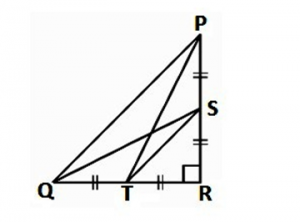
Applying Pythagoras theorem in ?PRT, we get
PR2 + RT2 = PT2 ………. (i)
Applying Pythagoras theorem in ?QRS, we get
QR2 + RS2 = QS2 ………. (ii)
Adding (i) + (ii), we get
PR2 + RT2 + QR2 + RS2 = PT2 + QS2 ………. (iii)
Applying Pythagoras theorem in ?RST, we get
ST2 = RS2 + RT2
Applying Pythagoras theorem in ?PQR, we get
PQ2 = PR2 + RQ2
Putting these values in equation (iii), we get
ST2 + PQ2 = PT2 + QS2.
Question 13:
The perpendicular from P on side QR of a ?PQR intersects QR at S such that SQ = 3RS. Prove that 2PQ2 = 2PR2 + QR2.

Solution:
Given that in ?PQR, we have
PS ? QR and SQ = 3RS
In right-angled triangles PSQ and PSR, we have
PQ2 = PS2 + QS2 ……. (i)
PR2 = PS2 + SR2 ……. (ii) [By Pythagoras theorem]
(ii) – (i), we get
PQ2 – PR2 = QS2 – SR2
= 9SR2 – SR2 [Since, SQ = 3SR]
= 8(QR/4)2 [Since, QR = SQ + RS = 3RS +RS = 4RS]
Therefore, PQ2 – PR2 = QR2/2
? 2(PQ2 – PR2) = QR2
Therefore, 2PQ2 = 2PR2 + QR2.
Question 14:
In an equilateral triangle PQR, S is a point on side QR such that QS = 1/3 QR. Prove that 9PS2 = 7PQ2.
Solution:

Let the side of the equilateral triangle be a, and PT be the altitude of ?PQR.
? QT = TR = QR/2 = a/2
And, PT = \(\frac{\sqrt{3}a}{2}\)
Given that, QS = 1/3 QR
? QS = a/3
ST = QT – QS = a/2 – a/3 = a/6
Applying Pythagoras theorem in ?PST, we get
PS2 = PT2 + ST2
PS2 = \((\frac{a\sqrt{3}}{2})^{2}\) + \((\frac{a}{6})^{2}\)
= \(\frac{3a^{2}}{4}\) + \((\frac{a^{2}}{36})\)
= \(\frac{28a^{2}}{36}\)
= \(\frac{7}{9}\) AB2
? 9AD2 = 7AB2
Question 15:
In an equilateral triangle, prove that three times the square of one side is equal to four times the square of its altitudes.
Solution:

Let the side of the equilateral triangle be a, and PO be the altitude of ?PQR.
? QO = OR = QR/2 = a/2
Applying Pythagoras theorem in ?PQO, we get
PQ2 = PO2 + QO2
\(a^{2} = AE^{2} + (\frac{a}{2})^{2}\) \(AE^{2} = a^{2} – \frac{a^{2}}{4}\) \(AE^{2} = \frac{3a^{2}}{4}\)
4AE2 = 3a2
? 4 x (Square of altitude) = 3 x (Square of one side)
Question 16:
Choose the correct solution and justify:
In ?PQR, PQ = 6?3 cm, PR = 12 cm and QR = 6 cm.
The angle Q is:
i) 120o
ii) 60o
iii) 90o
iv) 45o
Solution:

Given that, PQ = 6?3 cm, PR = 12 cm and QR = 6 cm
We can observe that
PQ2 = 108
PR2 = 144
And, BC2 = 36
PQ2 + BC2 = PR2
The given triangle, ?PQR is satisfying Pythagoras theorem.
Therefore, the triangle is a right-angled triangle at B.
? ?B = 90o
Hence, the correct option is (iii)