Maths Chapter-09: Some Applications of Trigonometry
1. If sun’s elevation is 45°. Find the length of the shadow of a pole of height 8 m.
In rt. ? PQR, \(\angle B=90°\) and \(\angle QPR= 45°\)
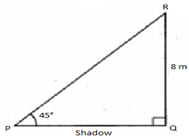
? tan 45° = \(\frac{QR}{PQ}\)
1 = \(\frac{8}{PQ}\)
\(\Rightarrow AB=\frac{8}{1}\) = 8m
2. A pole 8 metre high cast a shadow 8 m on the ground. Find the sun’s elevation.
In rt. ? PQR, \(\angle B=90°\)
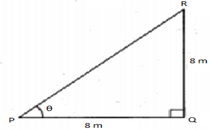
? PQ = 8 m
QR = 8 m
Let \(\angle QPR=\theta\)
? tan \(\theta\) = \(\frac{QR}{PQ}\)
= \(\frac{QR}{PQ}\) = 1
\(\theta\) = 45°
3. If the angle of elevation of the top of a hill from two points at distances p and q from the base and in the same straight line with it are complementary. Find the height of the hill.
Let PQ = h be the height of the hill,
QR = b, QS = a, such that \(\angle PSQ = \theta\)
\(\Rightarrow \angle PRQ= 90°-\theta\)
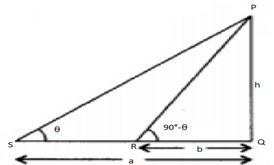
In rt. ? PQS, we have
\(\frac{h}{a}=tan\) \(\theta\)
h = a tan \(\theta\) …..(1)
In rt. ? PQR, we have
\(\frac{h}{b}=tan(90°-\theta )\) = cot \(\theta\)
h = b cot \(\theta\) …..(2)
Multiplying (1) and (2), we get
\(h^{2}\) = ab tan \(\theta\) cot \(\theta\) = ab
\(\Rightarrow h = \sqrt{ab}\)
4. From the figure, find the angle of depression of point Z from the point R.
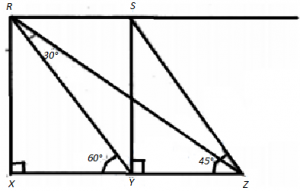
\(\angle YRS=\angle XYR\) (alternative.int. \(\angle a\) )
\(\Rightarrow \angle YRS\) = \(60°\)
\(\Rightarrow \angle ZRS+\angle YRZ=60°\) \(\Rightarrow \angle ZRS+30°=60°\) \(\Rightarrow \angle ZRS=30°\)
5. Find the angle of elevation of the moon when the shadow of a tree h metres high is \(\sqrt{3}\)h metres long.
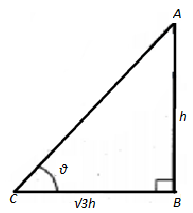
The height of the pole be h m and length of its shadow is \(\sqrt{3}\)h
Let \(\theta\) be the elevation of the sun.
Consider rt.agl ? ABC
tan \(\theta\) = \(\frac{h}{\sqrt{3}h}= \frac{1}{\sqrt{3}}\)
= tan \(30°\)
\(\Rightarrow\) \(\theta\) = \(30°\)
6. A ladder 14 metres long just reaches the top of a wall. If the ladder makes an angle of 45° with the wall, find the height of the wall.
Here, length of the ladder is 14m and angle of elevation is 90°-45°=45°.
Let h m be the height of the wall
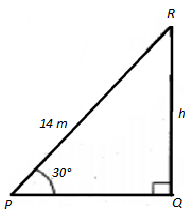
Consider rt.agl ? PQR
\(\frac{QR}{PR}\) = sin 30°
\(\frac{h}{14}=\frac{\sqrt{2}}{2}\)
h = \(\frac{14\sqrt{2}}{2}\) m
? The length of the wall is \(7\sqrt{2}\)
7. An observer 1.8 m tall is 20.8 m away from a tower 22.6 m high. Determine the angle of elevation of the top of the tower from the eye of the observer.
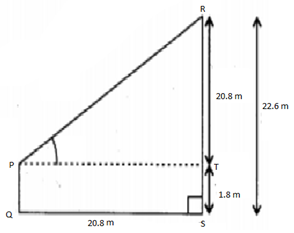
Here, PQ be the observer and RS be the tower of height 24 m.
PQ = TS = 1.8 m
RT = RS – TS
= 22.6 – 1.8
= 20.8 m
Now, Consider rt.agl ?PTR, we have
\(\frac{RT}{AT}\) = tan \(\theta\)
\(\frac{20.8}{20.8}\) = tan \(\theta\)
1 = tan \(\theta\)
tan \(45°\) = tan \(\theta\)
\(\theta\) =45°
8.From a balloon vertically above a straight road, the angles of depression of two cars at an instant is found to be 45° and 60°. If the car are 100 m apart, find the height of the balloon.
Let the height of the balloon at P be h metres. Let A and B be the two cars. Thus, AB = 100m.
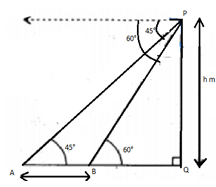
? PAQ= 45° and ? PBQ=60°
Now, Consider rt.agl ?AQP,
\(\frac{PQ}{AQ}\) = tan \(45°\)
\(\Rightarrow\) \(\frac{PQ}{AQ}\) = 1
\(\Rightarrow\) PQ = AQ= h m
Now, Consider rt.agl ?PBQ,
\(\frac{PQ}{BQ}\) = tan \(60°\)
\(\frac{PQ}{BQ}\) = \(\sqrt{3}\)
\(\frac{h}{h-100}\) = \(\sqrt{3}\)
h = \(\sqrt{3}h-\sqrt{3}(100)\)
\((\sqrt{3}-1)h\) = \(\sqrt{3}(100)\)
h = \(\frac{\sqrt{3}(100)}{\sqrt{3}-1}\)
h = \(\frac{\sqrt{3}(100)}{\sqrt{3}-1}\) \(\times \frac{\sqrt{3}+1}{\sqrt{3}+1}\)
h = \(\frac{\sqrt{3}(100)\left ( \sqrt{3}+1 \right )}{2}\)
= \(50(3+\sqrt{3})\)
9. The shadow of a tower on a level surface is 40 m long when moon’s elevation is 30° then when it is 60°.Find the height of the tower.
XY=40 m, \(\angle RXS\) =30°, \(\angle RYS\) = 60°

Now, Consider rt.agl ?RYS
\(\frac{RY}{SY}\) = tan 60°
\(\Rightarrow\) \(\frac{RY}{SY}\) = \(\sqrt{3}\)
\(\Rightarrow\) h = \(\sqrt{3}\) SY
Consider rt.agl ?RXQ
\(\frac{RX}{SX}\) = tan 30°
\(\Rightarrow\) \(\frac{RX}{XY+YS}\) = \(\frac{1}{\sqrt{3}}\)
\(\Rightarrow\) \(\frac{h}{40+YS}\) = \(\frac{1}{\sqrt{3}}\)
\(\Rightarrow\) \(\sqrt{3}\)h = 40 + YS
\(\Rightarrow\) \(\sqrt{3}\)h = 40 + \(\frac{h}{\sqrt{3}}\)
3h = 40\(\sqrt{3}\) + h
2h = 40\(\sqrt{3}\)
h = 20\(\sqrt{3}\)
? The height of the tower is 20\(\sqrt{3}\) m
10. From the top of a tree h m high, the angle of depression of two objects, which are in the line with foot of the tree are \(\gamma\) and \(\delta\) (\(\delta\)> \(\gamma\)). Find the distance between the two objects.
Let RS be the tree of height h m, X and Y are two objects such that
\(\angle RXS\) = \(\gamma\) , \(\angle RYS\) = \(\delta\)
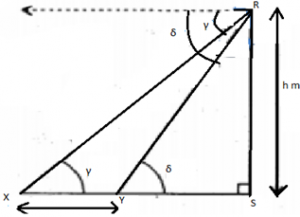
Now, Consider rt.agl ?YSR
\(\frac{RS}{YS}\) = tan \(\delta\)
\(\Rightarrow\) RS = YS tan \(\delta\) …..(i)
Now, Consider rt.agl ?XSR
\(\frac{RS}{XS}\) = tan \(\gamma\)
\(\Rightarrow\) \(\frac{RS}{XY+YS}\) = tan \(\gamma\)
\(\Rightarrow\) RS = (XY+YS) tan \(\gamma\) …..(ii)
\(\Rightarrow\) \(\frac{h}{tan \gamma }\) = XY + \(\frac{RS}{tan \delta }\) [using (i)]
\(\Rightarrow\) h cot \(\gamma\) = XY + h cot \(\delta\)
\(\Rightarrow\)
XY = h (cot \(\gamma\) + cot \(\delta\))
11. The angle of elevation of the top of a tower from two distinct points x and y from its foot are complementary. Prove that the height of the tower is \(\sqrt{xy}\).
Let h m be the height of the tower PQ. X and Y are two distinct points from its foot, such that PX = x and PY = y
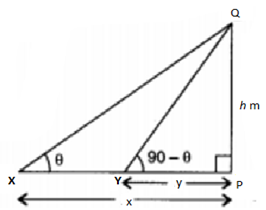
Now, Consider rt.agl ?XQP, we obtain
\(\frac{PQ}{PX}\) = tan \(\theta\)
\(\frac{h}{x}\) = tan \(\theta\)
h = x tan \(\theta\) …..(i)
Consider rt.agl ?YQP, we obtain
\(\frac{PQ}{PY}\) = tan \((90°-\theta )\)
\(\frac{h}{y}\) = cot \(\theta\)
h = y \(\times \frac{1}{tan\theta }\) …..(ii)
Multiply (I) and (ii), we get
\(h^{2}\) = x tan \(\theta\) \(\times y\times \frac{1}{tan\theta }\) = xy
h = \(\sqrt{xy}\)
? The height of the tower is \(\sqrt{xy}\).
12. The angle of elevation of the top of a tower from certain point at 30°. If the observer moves 10 m towards the tower, the angle of elevation of the top increases by 15° . Find the height of the tower.
Let h m be the height of the tower RS and P, Q are two points 10 m apaet, such that
\(\angle SPR= 30° and \angle SQR=45°\).
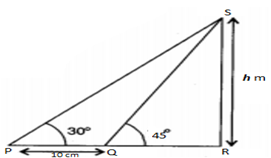
Now, Consider rt.agl ?QRS
\(\frac{SR}{QR}\) = tan 45°
\(\Rightarrow\) SR = QR = h m
Now, Consider rt.agl ?PRS
\(\frac{SR}{PR}\) = tan 30°
\(\Rightarrow\) \(\frac{h}{10+h}\) = \(\frac{1}{\sqrt{3}}\)
\(\Rightarrow\) \(\sqrt{3}\) h = 10 + h
(\(\sqrt{3}-1\)) h = 10
\(\Rightarrow\) h = \(\frac{10}{\sqrt{3}-1}\times \frac{\sqrt{3}+1}{\sqrt{3}+1}\) = \(\frac{10(\sqrt{3}+1)}{2}\)
? The height of the tower is 5(\(\sqrt{3}\)+1)
13. The angle of elevation of the top of a vertical tower from a point on the groung is 60°. From another point 10 m vertically above the first, its angle of elevation is 45°. Find the height of the tower.
Let XY be the vertical tower of height h m.
C and D are two points 10 m apart such that,
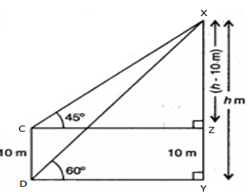
CD = ZY = 10 m \(\angle XCZ= 45° and \angle XBY=60°\)
XZ = XY – ZY = (h – 10) m
Consider rt.agl ?DYX
\(\frac{XY}{DY}\) = tan 60°
\(\frac{h}{DY}\) = \(\sqrt{3}\)
\(\Rightarrow\) DY = \(\frac{h}{\sqrt{3}}\)
Consider rt.agl ?CZX
\(\frac{XZ}{CZ}\) = tan 45°
XZ = CZ
H – 10 = \(\frac{h}{\sqrt{3}}\)
h \(\left ( 1-\frac{1}{\sqrt{3}} \right )\) = 10
h\(\left ( \frac{\sqrt{3}-1}{\sqrt{3}} \right )\) = 10
h = \(\frac{10\sqrt{3}}{\sqrt{3}-1}\times \frac{\sqrt{3}+1}{\sqrt{3}+1}\)
= \(\frac{10\sqrt{3}}{\sqrt{3}-1}\times \frac{\sqrt{3}+1}{\sqrt{3}+1}\)
= 5(3 + \(\sqrt{3}\))m
14. The angle of elevation of the top of a tower 27 m high from the foot of another tower in the same plane is 60° and the angle of elevation of the top of the second tower from the foot of the first tower is 30°. Find the distance between the two towers and the height of the other tower.
Let us assume that PQ and RS be the two tower of height h m and 27 m respectively.
\(\angle RQS\) = 60° \(\angle PSQ\) = 30°
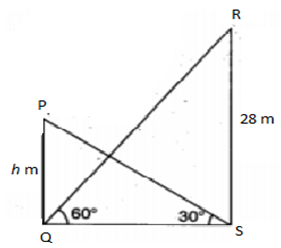
Consider rt.agl ?RQS
\(\frac{RS}{QS}\) = tan 60°
\(\frac{27}{QS}\) = \(\sqrt{3}\)
\(\Rightarrow\) QS = \(\frac{27}{\sqrt{3}}\) …..(i)
Consider rt.agl ?PSQ
\(\frac{PQ}{QS}\) = tan30°
\(\Rightarrow\) \(\frac{h}{QS}\) = \(\frac{1}{\sqrt{3}}\)
\(\Rightarrow\) \(\sqrt{3}\) h = QS …..(ii)
From (i) and (ii), we have
\(\sqrt{3}\) h = \(\frac{27}{\sqrt{3}}\)
\(\Rightarrow\) h = \(\frac{27}{3}\) = 9 m
From (ii), we get QS = 9\(\sqrt{3}\) m
? The distance between two towers is 9\(\sqrt{3}\) m and the height of the other tower is 9 m.
15. The lower window of a house is at a height of 3 m above the ground and its upper window is 6 m vertically above the lower window. At certain instant the angles of elevation of a balloon from these windows are observed to be 60° and 30° respectively. Find the height of the balloon from the ground.
Let P and Q be the positions of two windows of a house, such that PR = 3 m, QR = 9 m. Let U be the position of balloon of height h m above the ground. \(\angle UPS\) = 60°, \(\angle UQT\) = 30°, US = h – 3 and UT = h – 9
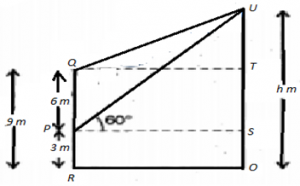
Consider rt.agl ?QTU
\(\frac{UT}{QT}\) = tan 30º
h – 9 = QT \(\times \frac{1}{\sqrt{3}}\)
\(\Rightarrow\) \(\sqrt{3}\) (h – 8) = QT …..(i)
Consider rt.agl ?UPS
\(\frac{US}{PS}\) = tan 60º
h – 3 = PS \(\times \sqrt{3}\)
\(\Rightarrow\) \(\frac{h-3}{\sqrt{3}}\) = PS …..(ii)
Also, QT = PS …..(iii)
From (i), (ii) and (iii), we get
\(\sqrt{3}\) (h – 9) = \(\frac{h-3}{\sqrt{3}}\)
\(\Rightarrow\) 3h -27 = h – 3
\(\Rightarrow\) 3h – h = 27 – 3
\(\Rightarrow\) 2h = 24
\(\Rightarrow\) h = 12
? height of the balloon above the ground is 12 m.