Alternating Currents and Voltages
When a battery is connected to a resistor, charge flows through the resistor in one direction only. If you want to reverse the direction of the current, you have to interchange the battery connections. However, the magnitude of the current will remain constant. Such a current is called direct current.
A current whose magnitude changes continuously and direction changes periodically, is said to be an alternating current.
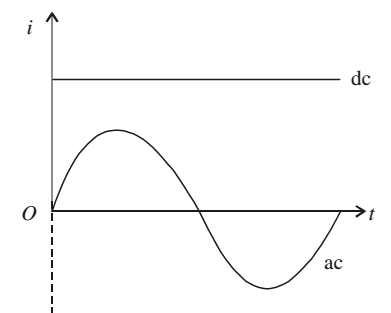
In general, alternating voltage and currents are mathematically expressed as
V = Vm cos ωt
I = Im cos ωt
Vm and Im are known as the peak values of the alternating voltage and current respectively.
The root mean square (rms) values of V and I are given as
Vrms = Vm/√2 = 0.707 Vm
Irms = Im/√2 = 0.707 Im
The relation between V and I depends on the circuit elements present in the circuit.