Artificial Satellites
If you project a body at an angle to the horizontal, it follows a parabolic path. Now imagine launching bodies with increasing force. Projectiles travel larger and larger distances before falling back to the earth. Eventually, the projectile goes into an orbit around the earth. It becomes an artificial satellite. Satellites like the moon are natural satellites.
In order to put a satellite in orbit, it is first lifted to a height of about 200 km to minimize loss of energy due to friction in the atmosphere of the earth. Then it is given a horizontal push with a velocity of about 8 kms–1. The orbit of an artificial satellite also obeys Kepler’s laws because the controlling force is gravitational force between the satellite and the earth. The orbit is elliptic in nature and its plane always passes through the center of the earth.
The orbital velocity of an artificial satellite has to be less than the escape velocity. Otherwise it will break free of the gravitational field of the earth and will not orbit around the earth. From the expressions for the orbital velocity of a satellite close to the earth and the escape velocity from the earth,
vorb = v/√2
Types of Orbits
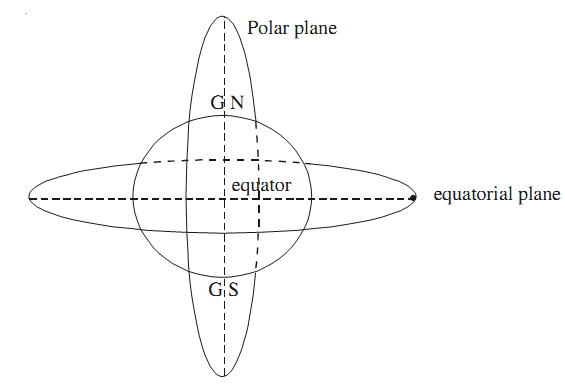
Artificial satellites have generally two types of orbits depending on the purpose for which the satellite is launched. Satellites used for tasks such as remote sensing have polar orbits. The altitude of these orbits is about 800 km. If the orbit is at a height of less than about 300 km, the satellite loses energy because of friction caused by the particles of the atmosphere. As a result, it moves to a lower height where the density is high. There it gets burnt. The time period of polar satellites is around 100 minutes.
It is possible to make a polar satellite sun-synchronous, so that it arrives at the same latitude at the same time every day. During repeated crossing, the satellite can scan the whole earth as it spins about its axis. Such satellites are used for collecting data for weather prediction, monitoring floods, crops, bush fires, etc.
Satellites used for communications are put in equatorial orbits at high altitudes. Most of these satellites are geo-synchronous, the ones which have the same orbital period as the period of rotation of the earth, equal to 24 hours. Their height is fixed at around 36000 km. Since their orbital period matches that of the earth, they appear to be hovering above the same spot on the earth.
A combination of such satellites covers the entire globe, and signals can be sent from any place on the globe to any other place. Since a geo-synchronous satellite observes the same spot on the earth all the time, it can also be used for monitoring any peculiar happening that takes a long time to develop, such as severe storms and hurricanes.