Atmospheric Pressure
The earth is surrounded by an atmosphere up to a height of about 200 km. The pressure exerted by the atmosphere is known as the atmospheric pressure.
A German Scientist O.V. Guericke performed an experiment to demonstrate the force exerted on bodies due to the atmospheric pressure. He took two hollow hemispheres made of copper, having diameter 20 inches and tightly joined them with each other. These could easily be separated when air was inside. When air between them was exhausted with an air pump, 8 horses were required to pull the hemispheres apart.
Toricelli used the formula for hydrostatic pressure to determine the magnitude of atmospheric pressure.
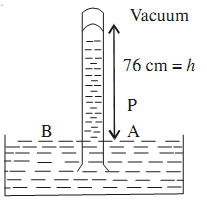
He took a tube of about 1 m long filled with mercury of density 13,600 kg m–3 and placed it vertically inverted in a mercury tub. He observed that the column of 76 cm of mercury above the free surface remained filled in the tube.
In equilibrium, atmospheric pressure equals the pressure exerted by the mercury column. Therefore,
Patm = h ρ g = 0.76 × 13600 × 9.8 Nm–2
Patm = 1.01 × 10⁵ Nm–2 = 1.01 × 10⁵ Pa