Bernoulli’s Principle
Bernoulli’s Principle states that where the velocity of a fluid is high, the pressure is low and where the velocity of the fluid is low, pressure is high.
Energy of a Flowing Fluid
Flowing fluids possess three types of energy - kinetic energy, potential energy and pressure energy. Pressure energy is due to the pressure of the fluid. It can be taken as the product of pressure difference and its volume. If an element of liquid of mass m, and density d is moving under a pressure difference p, then
Pressure energy = p × (m/d) joule
Pressure energy per unit mass = (p/d) J kg–1
Bernoulli’s Equation
Bernoulli developed an equation that expresses this principle quantitatively. Three important assumptions were made to develop this equation:
- The fluid is incompressible, i.e. its density does not change when it passes from a wide bore tube to a narrow bore tube.
- The fluid is non-viscous or the effect of viscosity is not to be taken into account.
- The motion of the fluid is streamlined.
Consider a tube of varying cross section. Suppose at point A the pressure is P1, area of cross section A1, velocity of flow v1, height above the ground h1 and at B, the pressure is P2, area of cross-section A2, velocity of flow = v2, and height above the ground h2.
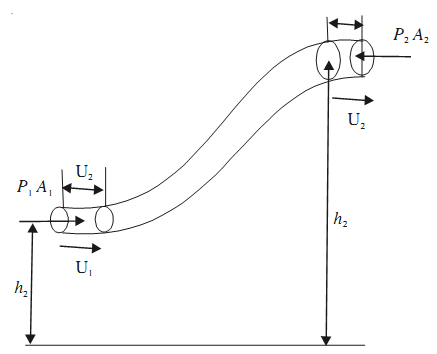
Since points A and B can be any two points along a tube of flow,
P + ½ dv2 + hdg = constant
The sum of pressure energy, kinetic energy and potential energy of a fluid remains constant in streamline motion.