Equation of Simple Harmonic Wave in One Dimension
Consider a simple harmonic wave propagating along OX. Assume that the wave is transverse and the vibrations of the particle are along YOY′.
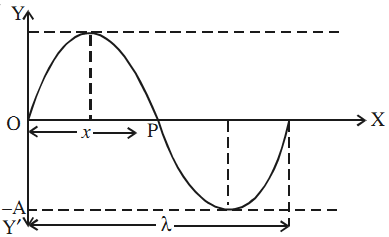
The displacement at t = 0 is given by the equation
y = a sin ωt
The phase of vibrations at that time at the point P lags behind by a phase, say φ. Then
y = a sin (ωt – φ)
Let OP = x. Since phase change per unit distance is k,
φ = kx.
Hence,
y(x, t) = a sin (ωt – kx)
As ω = 2π/t and k = 2π/λ,
y(x, t) = a sin 2π (t/T – x/λ)
In terms of wave velocity (v = λ/T), this equation can be expressed as
y = a sin 2π/λ (vt – x)
If the initial phase angle at O is φ0, the equation of the wave would be
y(x, t) = a sin [(ωt – kx) + φ0]
Phase difference between two points on a wave
Consider two simple harmonic waves travelling along OX and represented by the equations
y = a sin (ωt – kx)
y = a sin [ωt – k(x + ∆x)]
The phase difference between them is
∆φ = k∆x = 2π/λ . ∆x = –2π/λ (x2 – x1)
where ∆x is called the path difference between these two points. The negative sign indicates that a point positioned later will acquire the same phase at a later time.
Phase difference at the same position over a time interval ∆t
Consider two waves at the same position at a time interval ∆t.
∆φ = 2πf(∆t)