Kepler’s Laws of Planetary Motion
In ancient times it was believed that all heavenly bodies move around the earth. Greek astronomers lent great support to this notion. So strong was the faith in the earth-centred universe that all evidences showing that planets revolved around the Sun were ignored.
However, Polish Astronomer Copernicus in the 15th century proposed that all the planets revolved around the Sun. In the 16th century, Galileo, based on his astronomical observations, supported Copernicus. Another European astronomer, Tycho Brahe, collected a lot of observations on the motion of planets. Based on these observations, his assistant Kepler formulated laws of planetary motion.
Kepler formulated three laws which govern the motion of planets.
First Law
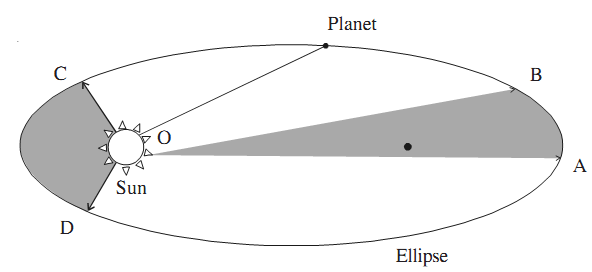
The orbit of a planet is an ellipse with the Sun at one of the foci.
Second Law
The area swept by the line joining the planet to the sun in unit time is constant through out the orbit.
Third Law
The square of the period of revolution of a planet around the sun is proportional to the cube of its average distance from the Sun.
T2 α r3