Law of Gravitation
It is said that Newton was sitting under a tree when an apple fell on the ground. This set him thinking: since all apples and other objects fall to the ground, there must be some force from the earth acting on them. He asked himself: Could it be the same force which keeps the moon in orbit around the earth?
Newton argued that at every point in its orbit, the moon would have flown along a tangent, but is held back to the orbit by some force.
He had deduced from Kepler’s laws that the force between the Sun and planets varies as 1/r2. Using this result he was able to show that it is the same force that keeps the moon in its orbit around the earth. Then he generalised the idea to formulate the universal law of gravitation.
Every particle attracts every other particle in the universe with a force which varies as the product of their masses and inversely as the square of the distance between them.
if m1 and m2 are the masses of the two particles, and r is the distance between them, the magnitude of the force F is given by:
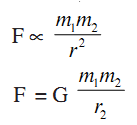
The constant of proportionality, G , is called the universal constant of gravitation. Its value remains the same between any two objects everywhere in the universe.
One of the extremely important characteristics of the gravitational force is that it is always attractive. It is also one of the fundamental forces of nature. The force is along the line joining the two particles.
The value of the constant G is so small that it could not be determined by Newton. It was determined by Cavendish for the first time about 100 years later. It is because of the smallness of G that the gravitational force due to ordinary objects is not felt by us.
G = 6.67 × 10⁻¹¹ Nm2kg–2