Laws of Reflection
First Law of Reflection
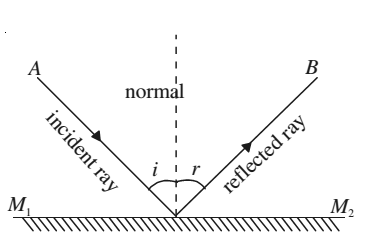
The incident ray, the reflected ray and the normal to the reflecting surface at the point of incidence always lie in the same plane.
Second Law of Reflection
The angle of incidence is equal to the angle of reflection .
∠i = ∠r
Spherical Mirrors
Though initially stated for plane surfaces, these laws are also true for spherical mirrors - convex mirror and concave mirror.
The centre of the sphere, of which the mirror is a part, is called the centre of curvature of the mirror and the radius of this sphere defines its radius of curvature. The middle point O of the reflecting surface of the mirror is called its pole. The straight line passing through C and O is said to be the principal axis of the mirror. The circular outline (or periphery) of the mirror is called its aperture.
A beam of light incident on a spherical mirror parallel to the principal axis converges to or appears to diverge from a common point after reflection. This point is known as principal focus of the mirror. The distance between the pole and the principal focus gives the focal length of the mirror. A plane passing through the focus perpendicular to the principal axis is called the focal plane.