Strain
Deforming forces produce changes in the dimensions of the body. The strain is defined as the change in dimension (length, shape or volume) per unit dimension of the body.
As the strain is ratio of two similar quantities, it is a dimensionless quantity.
Depending on the kind of stress applied, strains are of three types:
- Linear strain
- Volume (bulk) strain
- Shearing strain
Linear Strain
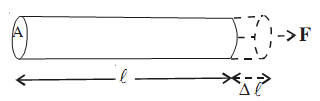
If on application of a longitudinal deforming force, the length L of a body changes by ∆L, then
linear strain = change in length / original length
= ∆L/L
Volume Strain
If on application of a uniform pressure ∆p, the volume V of the body changes by ∆V without change of shape of the body, then
Volume strain = change in volume / original volume
= ∆V/V

Shearing Strain
When the deforming forces are tangential, the shearing strain is given by the angle θ through which a line perpendicular to the fixed plane is turned due to deformation. (The angle θ is usually very small.)
θ = ∆x/y
