Neelakurinji Flowers
Neelakurinji is a little mauve flower. But the individual flower is not at all attractive for an ordinary man. However, the massive flowering is really a feast to the eyes of beholders. Neelakurinji (Strobilanthes kunthiana) is a unique species, which blooms in the altitudes between 1,600 and 2,695 meters in the Western Ghats. This species used to grow abundantly in the shola grass land above 1,800 meters.
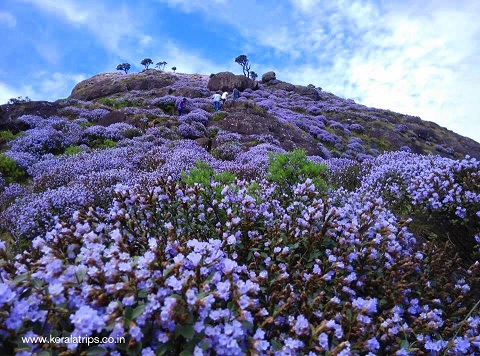
It is believed that the name Nilgiris (literally means Blue Mountains) itself came from the purplish blue flowers of Neelakurinji. This Neelakurinji belongs to the family of Acanthaceae. This genus has around 300 species. There are other Kurinji plants also. Its flowering cycles ranges from one to 16 years.
German Research
The 12-year cycle of Neelakurinji flowering was first recorded in the year 1838. There after many scientist groups had done studies on this rare species. The reason for this 12-year flowering cycle is yet to be scientifically established. The scientific name of Neelakurinji was changed several occasions and the name Strobilanthes kunthiana was finalized after the study of a German Scientists Team. The name Kunthiana came from the name of Kunth, a scientist in the German team. It has relation with the name of river Kunthi also.
Even though, Neelakurinji is found in many areas in and around Munnar, Eravikulam National Park area is most famous for its flowering. This National Park is a sanctuary for the endangered Nilgiri tahr.
Myths and Legends
Neelakurinji with 12-year flowering cycle has its own myths and legends. Some of the tribes in the Western Ghats area are not enthused by the blooming of Neelakurinji. At the same time some others consider it as God’s flower. Even some other tribes feel that the flowering will follow the supply of excess amount of honey from the area. It is also interesting to know that the Muduvar tribe in the area calculates their age in connection with the blossoming of Neelakurinji.
Protecting Endangered Plant
As Neelakurinji is an endangered plant, all the efforts are being made to protect its habitats. The process of converting Kurinji habitats into plantations in the past decades was the major threat for this plant. The Kerala Government has decided to set up a Kurinji Sanctuary in the Eravikulam area of Munnar.