Structure of Atmosphere
-
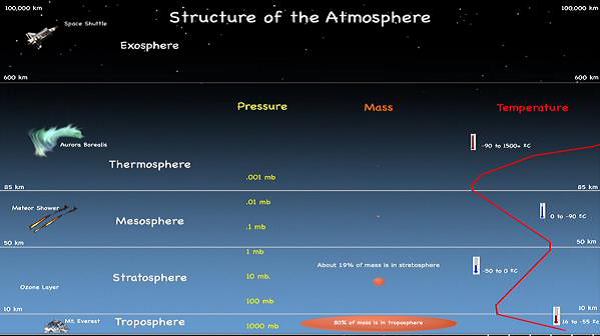
The structure of the atmosphere is classified into the following layers:
-
Troposphere: 0 to 12 km
-
Stratosphere: 12 to 50 km
-
Mesosphere: 50 to 80 km
-
Thermosphere: 80 to 700 km
-
Exosphere: 700 to 10,000 km
-
Troposphere
-
Troposphere is the closest to the Earth’s surface and contains water vapor (clouds), moisture, dust, etc.
-
Most of the weather phenomena take place in Troposphere.

-
Height of the Troposphere varies i.e. at the equator, it is measured about 18 km and at the poles, it is 12 km.
-
Tropopause is the transitional zone that separates Troposphere and Stratosphere.
Stratosphere
-
Stratosphere is the second-lowest layer of the Earth’s Atmosphere that goes up to 50 km.
-
Stratosphere contains Ozone (O3) Layer that absorbs the ultraviolet rays (coming through the Sun rays) and protects life on the Earth.
-
As the ultraviolet radiation absorbs in Stratosphere, therefore the temperature rises with increasing altitude.
-
The Stratopause is the transitional zone that separates Stratosphere and Mesosphere.
Mesosphere
-
Mesosphere, present above the Stratosphere, extends up to (from 50 km to) 80 km.
-
Temperature in the Mesosphere decreases with increasing altitude.
-
Mesopause is the transitional zone that separates Mesosphere and Thermosphere.
Thermosphere
-
Above the Mesosphere, Thermosphere is the second-highest layer that starts at the altitude of 80 km and extends up to (roughly) 700 km (however, it varies between 500 and 1000 km).
-
The lower part of the Thermosphere (roughly between 80 km and 550 km) contains ions and known as Ionosphere.
-
The temperature of the Thermosphere rises with increasing altitude.
-
Thermopause is the transitional zone that separates Thermosphere and Exosphere.
Exosphere
-
Exosphere is the highest or outermost layer of the Earth’s atmosphere that extends (starting from 700 km altitude) up to 10,000 km where it ultimately merges into the solar wind.
-
Major constituents of the Exosphere are helium, hydrogen, nitrogen, oxygen, and carbon dioxide.
-
The phenomena of Aurora Borealis and Aurora Australis can be seen in the lower part of the Exosphere (merged with upper part of the Thermosphere).
-
The Satellite (orbiting the Earth) is normally placed in the Exosphere (as shown in the image given above).