Concentration Equilibrium Constant
Consider the following equilibrium:
H2 (g) + I2 (g) ⇌ 2HI (g)
At equilibrium the concentrations of H2, I2 and HI become constant. Also, it has been found experimentally that irrespective of the starting concentrations of H2 and I2, the following ratio of concentration terms always remains constant.
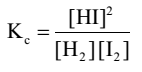
Here [H2], [I2] and [HI] represent the equilibrium molar concentrations of H2, I2 and HI respectively and Kc is called the concentration equilibrium constant. In general, for reversible reaction
aA + bB ⇌ cC + dD
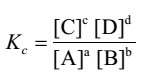
The above relation is known as the law of equilibrium. All the concentrations values in the law of equilibrium are the equilibrium concentrations of reactants and products. The numerator of the law of equilibrium is the product of equilibrium molar concentrations of products, each term being raised to the power equal to its stoichiometric coefficient in the chemical equation and the denominator contains products of similar concentration terms of reactants.