Hydration of Alkenes
Hydrationmeans addition of water molecule. In case of alkenes, hydration is the addition of H+ and OH– across the double bond to give alcohols.
Acid Catalysed Hydration
Alkenes can be hydrated to yield alcohols in the presence of acid catalysts. The reaction proceeds via alkyl hydrogen sulphate and this method is used for the industrial preparation of ethanol.

In case of unsymmetric alkenes, the addition follows Markovniokov’s rule.
Oxymercuration - Demercuration
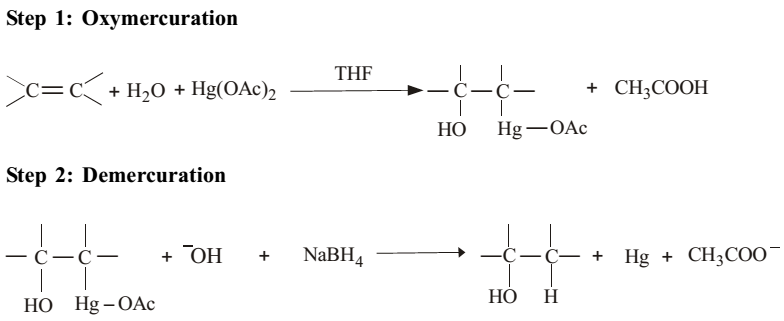
Alkenes react with mercury (II) acetate (mercuric acetate) in aqueous tetrahydrofuran (THF) solvent to give hydroxyalkyl mercury compounds which are reduced to alcohols by sodium borohydride.
Hydroboration - Oxidation
When an alkene reacts with BH3 (a boron hydride) in THF solution, an organoborane is obtained. Since BH3 has three hydrogens, above addition can occur three times to give trialkylborane (R3B). The trialkylborane so obtained is oxidised using alkaline hydrogen peroxide solution to give three molecules of alcohols and boric acid.
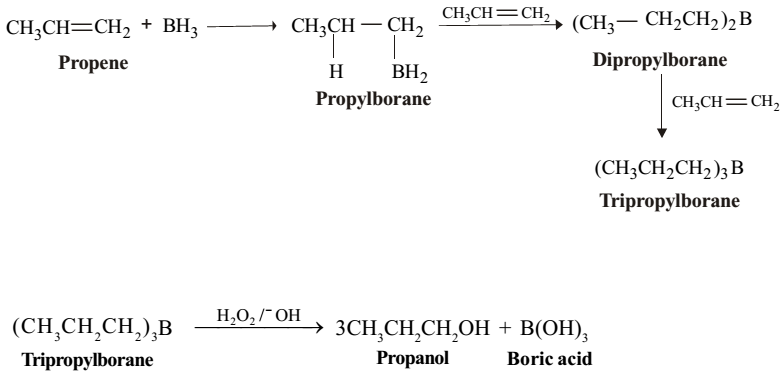
Hydroboration - oxidation yields the anti-Markovnikov addition of water although the reaction proceeds according to Markonikov’s rule.