Polydiens
These polymers are obtained when an unsaturated hydrocarbon with two double bonds or when a diene (2 double bond compound) is polymerized with a substituted alkene. The polymers belonging to this class are rubbers or elastomer. They can be natural or artificial.
Natural Rubber
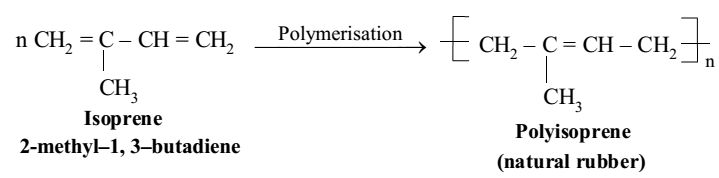
It is a polymer of unsaturated hydocarbon, 2-methyl-1, 3-butadiene also called isoprene. It is obtained from the latex of rubber trees. The latex contains about 25-40% of rubber hydrocarbons dispersed in water alongwith stabilizer proteins and some fattyacids. It is a natural polymer and possess remarkable elasticity. It undergoes long range reversible extension under relatively small applied force. In natural rubber 10,000 to 20,000 isoprene units are linked together.
Synthetic Rubbers
Synthetic high polymers possessing similar physical properties as that of natural rubber are called synthetic rubber. Usually synthetic rubber is an improvement over natural rubber, specially with respect to its resistance to oils, gas, solvents, etc.
Neoprene: This synthetic rubber resembles natural rubber in its properties. It is obtained by polymerization of chloroprene. Neoprene is superior to natural rubber in its stability to aerial oxidation and its resistance to oils, gasoline and other solvents.
Buna - S: It is obtained by polymerization of butadiene and styrene in presence of sodium metal. In Buna - S, Bu stands for butadiene, Na for sodium and S stands for styrene. It is also called S.B.R. (Styrene Butadiene Rubber). It has slightly less tensile strength than natural rubber.
Buna - N: It is obtained by co-polymerization of two parts of butadiene and one part of acrylonitrile in presence of sodium metal. Buna - N is hard and extremely resistant to the swelling action by oils (petrol), solvents and is resistant to heat, etc.
Butyl Rubber: This is obtained as a result of co-polymerization of butadiene and isobutylene. It is generally carried out in the presence of small quantity of isoprene. Butyl rubbers are inert towards acids and alkalies, but have poor resistance towards petroleum products.