Proteins
Proteins are high molecular mass complex amino acids. A living system contains thousands of different proteins for its various functions. Everyday food items like pulses, eggs, meat and milk are rich sources of proteins and are must for a balanced diet.
Classification of Proteins
Proteins are classified on the basis of their chemical composition, shape and solubility.
Simple Proteins
Simple proteins are those which, on hydrolysis, give only amino acids. According to their solubility, the simple proteins are further divided into two major groups fibrous and globular proteins.
Conjugated Proteins
Conjugated proteins are complex proteins which on hydrolysis yield not only amino acids but also other organic or inorganic components. The non-amino acid portion of a conjugated protein is called prosthetic group.
Structure of Proteins
Protein molecules are polymers of different sizes and shapes with different physical and chemical properties. The monomer units for proteins are amino acids. All the amino acids
that are found in proteins have an amino group (-NH2) on the carbon atom adjacent to carbonyl group, hence are called α-amino acids.
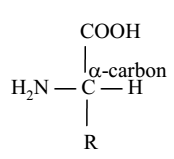
All proteins found in nature are the polymers of about twenty different α-amino acids and all of these have L-configuration. Out of these, ten amino acids cannot be synthesized by our body and hence must form the part of our diet. These are called essential amino acids.
All proteins have one common structural feature that their amino acids are connected to one another by peptide linkages.