Structural Isomerism
Compounds which have the same molecular formula but differ in their structure are called structural isomers and the phenomenon is called structural isomerism. This is further subdivided into four types:
- Chain Isomerism
- Functional Isomerism
- Positional Isomerism
- Metamerism
Chain Isomerism
These isomers differ in the chain of the carbon atoms. For example, n-butane and isobutane are two isomers of C4H10.

Functional Isomerism
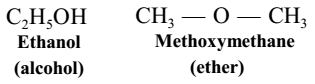
These isomers differ in the type of functional group. For example, ethanol and ether are the two isomers having molecular formula C2H6O, belong to two different classes of organic compounds.
Positional Isomerism
These isomers differ in the attachment of the functional group to the chain at different positions.

Metamerism
Metamerism is exhibited by those compounds in which functional group comes in between the carbon chain and breaks the continuity of the chain. This breaking occurs at different positions and different isomers are formed which are called Metamers.
For example, 1-methoxypropane and ethoxyethane are two metamers differing in chain length (size of alkyl groups) on the two sides of oxygen atom.
