Structure & Physical Properties of Aldehydes & Ketones
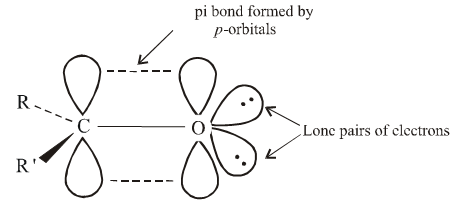
In both aldehydes and ketones, the carbonyl carbon and oxygen atoms are sp2 hybridised. Therefore, the groups attached to the carbon atom and oxygen are present in a plane.
A π-bond is formed by the overlap of p-orbitals of carbon and oxygen atoms. The p-orbitals are present in a plane perpendicular to the plane of the molecule.
Polarisation
Oxygen is more electronegative than carbon. Hence, it attracts the electrons of the carbon-oxygen double bond resulting in its polarisation.

The oxygen atom acquires a partial negative charge (δ-) whereas the carbon atom gets a partial positive charge (δ+). This polar nature of the carbonyl group makes the oxygen atom nucleophilic and basic while the carbon atom becomes electrophilic. The physical properties and chemical reactions of aldehydes and ketones are a direct consequence of this polarisation.
Boiling Point
The dipole-dipole attraction between the molecules of aldehydes and ketones results in their higher boiling points as compared to the hydrocarbons of similar molecular weight.
Solubility
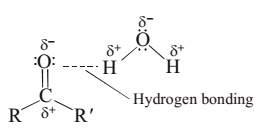
Carbonyl compounds have appriciable water solubility. This is because of the hydrogen bonding possible between the oxygen atom of the aldehyde (or the ketone) with hydrogen atom of water molecule.