Maths Chapter-06: The Triangle and its Properties
Exercise 6.1
Question 1:
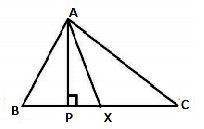
In ? ABC, X is the midpoint of BC.
AP is _____________
AX is _____________
Is BP = PC?
Answer:
Given:
BX = XC
Therefore, AP is altitude.
AX is a median.
No, BP ? PC as X is the midpoint of BC
Question 2:
Draw a sketch for the following:
(i) In ? PQR, QX is a median
(ii) In ? ABC, AB and AC are altitudes of a triangle.
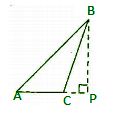
(iii) In ABC, BP is an altitude in the exterior of a triangle.
Answer:
(i) Here, QX is a median in ?PQR and PX = XR
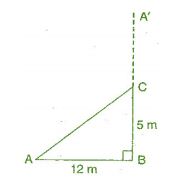
(ii) Here, AB and AC are the altitudes of the ?ABC and CA ^ BA
(iii) BP is an altitude in the exterior of ?ABC
Question 3:
Verify by drawing a diagram if the median and altitude of a isosceles triangle can be same.
Answer:
Isosceles triangle means any two sides are same.
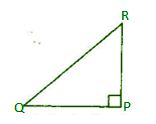
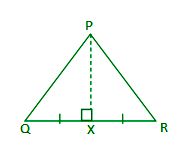
Take ?PQR and draw the median when PQ= PR
PX is the median and altitude of the given triangle.
Exercise 6.2
Question 1:
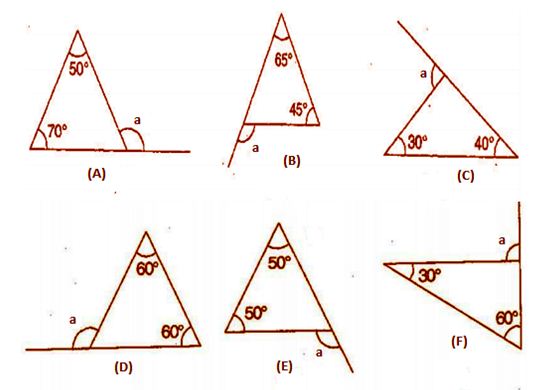
Find the value of the unknown exterior angle a in the following diagrams:
Answers:
Since the exterior angle = sum of the interior opposite angles, then
(a) a = 500 + 70 0 = 1200
(b) a = 650 + 450 = 1100
( c) a = 300 + 400 = 700
(d ) a = 600 + 600 = 1200
(E) a = 500 + 500 = 1000
(F) a = 600 + 300 = 900
Question 2:
Find the value of the unknown interior angle a in the following figures:

Answers:
Since the exterior angle = sum of the interior opposite angles, then
(a) a + 50o = 115o => a = 115o – 50 o = 65 o
(b) 70 o + a = 100o => a = 100o – 70o = 30o
( c) a + 90o = 125o => a = 120 o – 90 o = 35 o
(d) 60 o + a = 120 o => a = 120 o – 60 o = 60 o
(e) 30 o + a = 80 o => a = 80 o +30 o = 50 o
(f) a + 35 o = 75 o => a = 75 o – 35 o = 40 o
Exercise 6.3
Question 1:
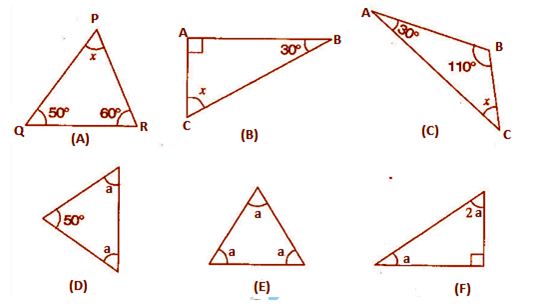
Find the value of the unknown a in the following given diagrams.
Answers:
(a) In \(\Delta\) PQR
\(\angle\) QPR + \(\angle\) PRQ + \(\angle\) PQR = 180o [ By angle sum property of a triangle]
=> a + 50o + 60o = 180o
=> a + 110o = 180o
=> a = 180o – 110 = 70o
(b) In \(\Delta\) ABC,
\(\angle\) CAB + \(\angle\) ABC + \(\angle\) CAB = 90o [ By angle sum property of a triangle]
=> 90o + 30o + a = 180o
=> a + 120o = 180o
=> a = 180o – 120o = 60o
(c ) In \(\Delta\) ABC ,
\(\angle\) CAB + \(\angle\) ABC + \(\angle\) BCA = 180o [ By angle of sum property of a triangle]
=> 30o + 110o + a = 180o
=> a + 140o = 180o
=> a = 180o – 140O = 40O
(d) In the given isosceles triangle,
a + a + 50o = 180o
=> 2a + 50o = 180o
=> 2a = 180o – 50o
=> 2a = 130o
=> \(a = \frac{130^{\circ}}{2}\) = 65o
(e) In the given equilateral triangle,
a + a + a = 180o [ By angle sum property of a triangle]
=> 3 a = 180o
=> \(a = \frac{180^{\circ}}{3}\) = 60o
(f) In the given right angled triangle,
a + 2a + 90o = 180o [ By the angle sum property of a triangle]
=> 3a + 90o = 180o
=> 3a = 180o – 90o
=> 3a = 90o
=> \(a = \frac{90^{\circ}}{3}\) = 30o
Question 2
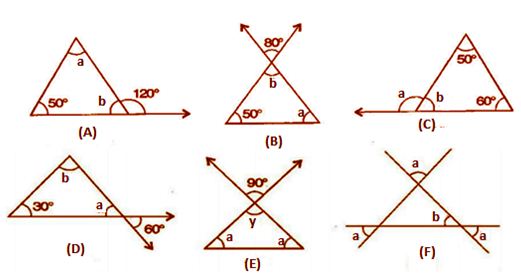
Find the values a and b in the following diagrams that are given below:
Answers:
(a) 50o + a = 120o [Exterior angle property of a \(\Delta\) ]
=> a = 120 o – 50 o = 70 o
Now, 50 o + a + b = 180 o [Angle sum property of a \(\Delta\) ]
=> 50 o + 70 o + b = 180 o
=> 120 o + b = 180 o
=> b = 180 o – 120 o = 60 o
(b) b = 80 o – – – – – – – – – – – (1) [ Vertically opposite angle]
Now, 50 o + a + b = 180 o [ Angle sum property of a \(\Delta\) ]
=> 50 o + 80 o + b = 180 o [From equation (1) ]
=> 130 o + b = 180 o
=> b = 180 o – 130 o = 50 o
( c) 50 o + 60 o = a [Exterior angle property of a \(\Delta\) ]
=> a = 110 o
Now, 50 o + 60 o + b = 180 o [Angle sum property of a \(\Delta\) ]
=> 110 o + b = 180 o
=> b = 180 o – 110 o
=> b = 70 o
(d) a = 60 o – – – – – – – – – – – – – – – (1) [ Vertically opposite angle]
Now, 30 o + a + b = 180 o [ Angle sum property of a \(\Delta\) ]
=> 50 o + 60 o + b = 180 o [From equation (1) ]
=> 90 o + b = 180 o
=> b = 180 o – 90 o = 90 o
(e) b = 90 o – – – – – – – – – – – – – (1) [ Vertically opposite angle]
Now, b + a + a = 180 o [ Angle sum property of a \(\Delta\) ]
=> 90 o + 2a = 180 o [From equation (1) ]
=> 2a = 180 o – 90 o
=> 2a = 90 o
=> \(a=\frac{90^{\circ}}{2}\) = 45o
(f) a = b – – – – – – – – – – – (1) [ Vertically opposite angle]
Now, a + a + b = 180 o [ Angle sum property of a \(\Delta\) ]
=> 2a + a = 180 o [From equation (1) ]
=> 3a = 180 o
=> \(a=\frac{180^{\circ}}{3}\) = 60o
Exercise 6.4
Question 1:
Is it possible to have a triangle with the following sides?
(a) 2cm, 3cm 5cm
(b) 3cm, 6cm, 7cm
(c) 6cm, 3cm, 2cm
Answer:
Since the triangle is possible having its sum of the lengths of any two sides would be greater than that length of the third side.
(a) 2cm , 3cm 5cm
2 + 3 > 5 No
2 + 5 > 3 Yes
3 + 5 > 2 Yes
This triangle is not possible.
(b) 3cm, 6cm and 7cm
3 + 6> 7 Yes
6 + 7 > 3 Yes
3 + 7 > 6 Yes
This triangle is possible.
( c) 6cm, 3cm and 2cm
6 + 3 > 2 Yes
6 + 2 > 3 Yes
2 + 3 > 6 No
This triangle is not possible.
Question 2:
Take any point P in the interior of a triangle ABC is:
(a) PA + PB > AB?
(b) PB + PC > BC?
(C ) PC + PA > CA?
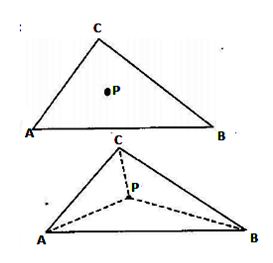
Answers:
Join PC, PB and PA
(a) Is PA + PB > AB?
Yes, APB forms a triangle.
(b) Is PB + PC > BC?
Yes, CBP forms a triangle.
( c) Is PC + PA > CA?
Yes, CPA forms a triangle.
Question 3:
PO is a median of a triangle PQR. Is PQ + QR + RP > 2PO? (Consider the sides of a triangle as \(\Delta\) PQO and \(\Delta\) POR )
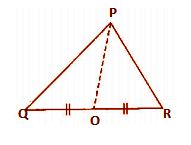
Answer:
Since, the sum of the lengths of any two sides in a triangle should be greater than the length of the third side.
Therefore,
In \(\Delta\) PQO, PQ + QO > PO – – – – – – – – – – (1)
In \(\Delta\) POR, PR + OQ > PO – – – – – – – – – – – (2)
Adding equation (1) and (2) we get,
PQ + PO + PR + OR > PO + PO
=> PQ + PR + ( QO + OR ) > 2PO
=> PQ + PR + QR > 2 PO
Hence, it is true.
Question 4:
PQRS is a quadrilateral. Is PQ + QR + RS + RP > PR + QS ?
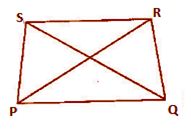
Answer:
Since, the sum of lengths of any two sides in a triangle should be greater than the length of the third side.
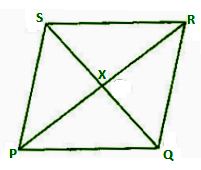
Therefore,
In \(\Delta\) PQR, PQ + QR > PR – – – – – – – – – – (1)
In \(\Delta\) PSR, PS + SR > PR – – – – – – – – – (2)
In \(\Delta\) SRQ, SR + RQ > SQ – – – – – – – – – (3)
In \(\Delta\) PSQ, PS + PQ > SQ – – – – – – – – – – (4)
Adding the equations (1) , (2) , (3) and (4) we get,
PQ + QR + PS + SR + RQ + PS + PQ > PS + PS + SQ + SQ
=>( PQ + PQ ) + ( QR + QR ) + ( PS + PS ) + ( SR + SR ) > 2 PR + 2 SQ
=> 2 PQ + 2 QR + 2 PS + 2 SR > 2 PR + 2 SQ
=> 2 ( PQ + QR + PS + SR) > 2 ( PR + SQ )
=> PQ + QR + PS + SR > PR + SQ
=> PQ + QR + RS + SP > PR + SQ
Hence, it is true.
Question 5:
PQRS is a quadrilateral. Is PQ + QR + RS + SA < 2 (PR + QS)?
Answer:
Since the sum of the lengths of any two sides of a triangle should be greater than the length of the third side.
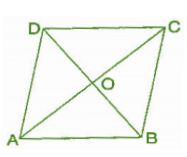
Therefore,
In \(\Delta\) PXQ, PQ < XP + XQ – – – – – – – – – – (1)
In \(\Delta\) QXR, QR < XQ + XR – – – – – – – – – – – (2)
In \(\Delta\) RXS, RS < XR + XS – – – – – – – – – – – (3)
In \(\Delta\) PXS, SP < XS + XP – – – – – – – – – – (4)
Adding the equations (1) , (2) , (3) and (4) We get,
PQ + QR + RS + SP < XP + XQ + XQ + XR + XR + XS + XS + XP
=> PQ + QR + RS + SP < 2XP + 2 XQ + 2 XR + XS
=> PQ + QR + RS + SP < 2[(PX + XR) + (XS + XQ)]
=> PQ + QR + RS + SP < 2[PR + QS]
Hence it is proved.
Question 6:
The lengths of the two sides of a given triangle are 12cm and 15cm respectively. Between what two measures should the length of the third side fall?
Answer:
Since, the sum of the lengths of any two sides of a triangle should be greater than the length of the third side.
It is given that the two sides of a triangle are 15cm and 12cm.
Therefore, the third side should be less than 15+ 12 = 27cm
Also that, the third side cannot be less than the difference of the other two sides.
Therefore, the third side has to be greater than 15-12 = 3cm.
Hence, the third side could be the length more than 3cm and less than 27cm.
Exercise. 6.5
Question 1:
ABC is a right angled triangle with \(\angle B = 90^{\circ}\). If AB = 12mm and BC = 5mm, find AC.
Answer:
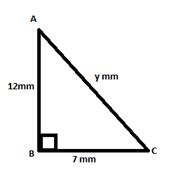
Here AB = 12mm and BC = 5mm (given)
Assuming AC = y mm.
\(AC^{2} = AB^{2} + BC^{2}\)In \(\triangle ABC\) by applying Pythagoras theorem, we get
\( y^{2} = 12^{2} + 5^{2}\) \(\ therefore y^{2} = 144 + 25\) \(?y^{2} = 169\) \(? y = \sqrt{169} = 13mm\)
Thus, AC = 13mm
Question 2:
XYZ is a right angled triangle with \(\angle Y = 90^{\circ}\). If XZ = 5cm and YZ = 3cm, find XY.
Answer:
Assuming XY = acm.
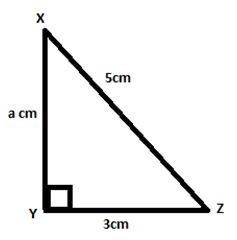
Here XZ = 5cm and YZ = 3cm (given)
In \(\triangle XYZ\) by applying
Pythagoras theorem, we get
\(XZ^{2} = XY^{2} + YZ^{2}\) \(\ therefore a^{2} = 5^{2} – 3^{2}\) \(\ therefore a^{2} = 25 – 9 \) \(? a^{2} = 16\) \(? a = \sqrt{16} = 4cm\)
Thus, XY = 4cm
Question 3:
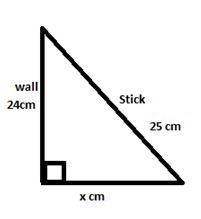
A 25cm long stick is rested on a wall at a point 24cm high on the wall. If the stick is at a distance x cm from wall on the ground, find the distance x.
Answer:
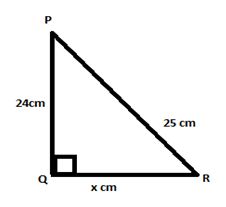
Let PR be the stick and P be the point where the stick touches the wall.
So, it becomes right angled triangle with \(\angle Q = 90^{\circ}\)
In \(\triangle PQR\) by applying Pythagoras theorem, we get
\( x^{2} =25^{2} – 24^{2}\)\(PR^{2} = PQ^{2} + QR^{2}\)
\(\ therefore x^{2} = 625 – 576 \) \(?x^{2} = 49\) \(? x = \sqrt{49} = 7cm\)
Thus, QR = 7cm
Question 4:
Which of the given below could be the lengths of the side of a right angled triangle?
- 5mm, 1.2mm, .9mm
- 3mm, 2mm, 1mm
- 1mm, 4mm, 9mm
Answer:
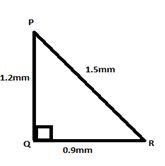
Assuming that the hypotenuse is the side with largest length so as per Pythagoras Theorem,
\((Hypotenuse)^{2} = (Perpendicular)^{2} + (Base)^{2}\)
5mm, 1.2mm, 0.9mm
Let \(\triangle PQR\) be the right angles triangle with \(\angle Q = 90^{\circ}\).
So, by Pythagoras theorem
\( 1.2^{2} + 0.9^{2} = 2.25\)\(PR^{2} = PQ^{2} + QR^{2}\)
\(? 1.5^{2} = 2.25 \)
R.H.S = L.H.S
Therefore, 1.5mm, 1.2mm, 0.9mmare
The lengths of the side of a right angled triangle.
3mm, 2mm, 1mm
Let \(\triangle PQR\) be the right angles triangle with \(\angle Q = 90^{\circ}\).
So, by Pythagoras theorem
\(PR^{2} = PQ^{2} + QR^{2}\) \(\ therefore 2^{2} + 1^{2} = 5\) \(? 3^{2} = 9 \) \(R.H.S \neq L.H.S\)
Therefore, 3mm, 2mm, 1mm are not
the lengths of the side of a right angled triangle.
1mm, 4mm, 0.9mm
Let \(\triangle PQR\) be the right angles triangle with \(\angle Q = 90^{\circ}\).
So, by Pythagoras theorem
\(PR^{2} = PQ^{2} + QR^{2}\) \(\ therefore 4^{2} + 0.9 ^{2} = 16.81\) \(? 4.1^{2} = 16.81 \)
R.H.S = L.H.S
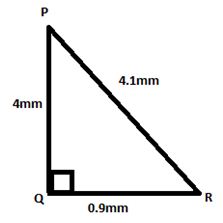
Therefore, 4.1mm, 4mm, 0.9mm are
the lengths of the side of a right angled triangle.
Question 5:
A pole is broken at the height of 500cm from the footpath and its peak point is in contact with the footpath at a distance of 1200cm from the base of the pole. Find the actual length when it was in normal condition.
Answer: Let \(\triangle PQR\)be the right angles triangle with \(\angle Q = 90^{\circ}\) representing the pole broken at point P and touches the footpath at point R and Q is the base of the pole.
Here, PQ = 500cm, QR = 1200cm ,
Let PR = x cm
In \(\triangle PQR\) by applying Pythagoras theorem, we get
\(PR^{2} = PQ^{2} + QR^{2}\) \(\ therefore x^{2} =500^{2} + 1200^{2}\) \(?x^{2} = 250000 + 1440000 \) \(?x^{2} = 1690000\) \(? x = \sqrt{49} = 1300cm\)
Thus, PR = 1300cm
Now the actual length of the pole = PQ + PR
= 500 + 1300
= 1800cm
Thus, the actual length of the pole is 1800cm.
Question 6:
In \(\triangle XYZ\)
Find out the correct one from equations given below, \(\angle Y\; = 35^{\circ} and\;\angle Z=55^{\circ}\)
- \(XZ^{2} = XY^{2} + YZ^{2}\)
- \(XY^{2} = YZ^{2} + XZ^{2}\)
- \(YZ^{2} = XY^{2} + XZ^{2}\)
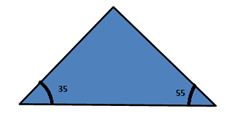
Answer: In \(\triangle XYZ\)
\(\angle XYZ + \angle YZX + \angle YXZ = 180^{\circ}\)
- \(35^{\circ} + 55^{\circ} +\angle YXZ = 180^{\circ}\)
- \(\angle YXZ = 180^{\circ} – (35^{\circ} + 55^{\circ})\)
- \(\angle YXZ = 180^{\circ} – 90^{\circ}\)
- \(\angle YXZ = 90^{\circ}\)
So, \(\triangle XYZ\) is a right angled triangle with \(\angle X = 90^{\circ}\).
Thus, \((Hypotenuse)^{2} = (Perpendicular)^{2} + (Base)^{2}\)
- \(YZ^{2} = XY^{2} + XZ^{2}\)
Thus, (c) is the correct option.
Question 7:
For a rectangle it is given that, width of a rectangle is 15mm and diagonal is 17 mm, then find the perimeter of the rectangle.
Answer: Let WXYZ be a rectangle.
Let the length of a rectangle is y mm.
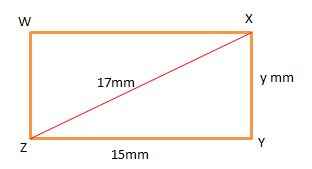
In \(\triangle XYZ\) by applying
Pythagoras theorem, we get
\(XZ^{2} = YZ^{2} + XY^{2}\) \(? 17^{2} =15^{2} + y^{2}\) \(?y^{2} = 289 – 225 \) \(?y^{2} = 64\) \(? y = \sqrt{64} = 8mm\)
Thus, XY = 8mm
Thus, the length of a rectangle is 8mm.
Now, perimeter of rectangle = 2 (XY + YZ) = 2(8 + 15)
= 46mm
Thus, the perimeter of the rectangle is 46mm.
Question 8:
For a rhombus the length of diagonals are given 80mm and 18mm.Then determine the perimeter of the rhombus.
Answer: Let PQRS be the rhombus.
Let the length of side of rhombus is x mm.
Also PR = 18mm, SQ = 80mm
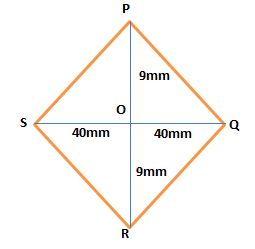
As the diagonals bisect each other at right angle in case of rhombus,
So, OP = PR/2 = 18/2 = 9mm
And SO = SQ/2 = 80/2 = 40mm
In \(\triangle POS\) by applying
Pythagoras theorem, we get
\(PS^{2} = OP^{2} + SO^{2}\) \(?x^{2} =9^{2} + 40^{2}\) \(?x^{2} = 81 + 1600 \) \(?x^{2} = 1681\) \(? x = \sqrt{1681} = 41mm\)
Thus, PS = 41mm
Now, the perimeter of the rhombus is = 4\(\times\)Length of side of rhombus = 4\(\times\)PS
= 4\(\times\)41 = 164mm
Thus, the perimeter of the rhombus is 164mm.