Maths Chapter-07: Congruence of Triangles
1. In quadrilateral ACBD, AC = AD and AB bisects \(\angle\)A . Show that \(\Delta\)ABC \(\cong\) \(\Delta\)ABD. What can you say about BC and BD?
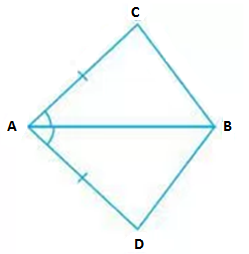
Sol.
Given that,
AC = AD and AB bisects \(\angle\)A
To prove that,
\(\Delta\)ABC \(\cong\) \(\Delta\)ABD
Proof,
In \(\Delta\)ABC and \(\Delta\)ABD,
AB = AB
AC = AD
\(\angle\)CAB =\(\angle\)DAB (AB is bisector)
Therefore, \(\Delta\)ABC \(\cong\) \(\Delta\)ABD by SAS congruence condition.
BC and BD are of equal length.
2. ABCD is a quadrilateral in which AD = BC and \(\angle\)DAB = \(\angle\)CBA . Prove that
(i) \(\Delta\)ABD \(\cong\) \(\Delta\)BAC
(ii) BD = AC
(iii) \(\angle\)ABD = \(\angle\)BAC.
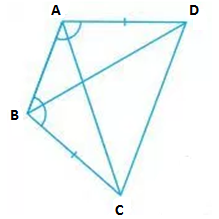
Sol.
Given that ,
AD = BC and \(\angle\) DAB = \(\angle\)CBA
(i) In \(\Delta\)ABD and \(\Delta\)BAC,
AB = BA (Common)
\(\angle\) DAB = \(\angle\)CBA (Given)
AD = BC (Given)
Therefore, \(\Delta\)ABD \(\cong\) \(\Delta\)BAC by SAS congruence condition.
(ii) Since, \(\Delta\)ABD \(\cong\) \(\Delta\)BAC
Therefore BD = AC by CPCT
(iii) Since, \(\Delta\)ABD \(\cong\) \(\Delta\)BAC
Therefore \(\angle\) ABD \(\cong\) \(\angle\)BAC by CPCT
3. AD and BC are equal perpendiculars to a line segment AB . Show that CD bisects AB.
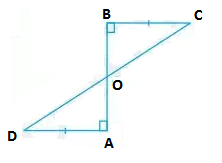
Sol.
Given that,
AD and BC are equal perpendiculars to AB.
To prove,
CD bisects AB
Proof,
In \(\Delta\)AOD and \(\Delta\)BOC,
\(\angle\)A = \(\angle\)B (Perpendicular)
\(\angle\)AOD = \(\angle\)BOC (Vertically opposite angles)
AD = BC (Given)
Therefore, \(\Delta\)AOD \(\cong\) \(\Delta\)BOC by AAS congruence condition.
Now,
AO = OB (CPCT). CD bisects AB.
4. l and m are two parallel lines intersected by another pair of parallel lines p and q . Show that \(\Delta\)ABC \(\cong\) \(\Delta\)CDA.
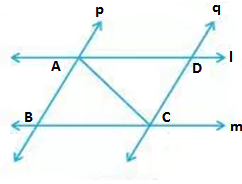
Sol.
Given that,
l \(\parallel\) m and p \(\parallel\) q
To prove,
\(\Delta\)ABC ? \(\Delta\)CDA
Then Proof that,
In \(\Delta\)ABC and \(\Delta\)CDA,
\(\angle\)BCA =\(\angle\)DAC (Alternate interior angles)
AC = CA (Common)
\(\angle\)BAC = \(\angle\)DCA (Alternate interior angles)
Therefore, \(\Delta\)ABC \(\cong\) \(\Delta\)CDA by ASA congruence condition.
5. Line l is the bisector of an angle \(\angle\)A and B is any point on l. BP and BQ are perpendiculars from B to the arms of \(\angle\)A . Show that:
(i) \(\Delta\)APB \(\cong\) \(\Delta\)AQB
(ii) BP = BQ or B is equidistant from the arms of \(\angle\)A. 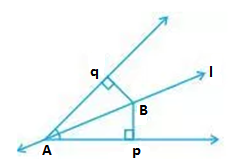
Sol.
Given,
l is the bisector of an angle \(\angle\)A.
BP and BQ are perpendiculars.
(i) In \(\Delta\)APB and \(\Delta\)AQB,
\(\angle\)P = \(\angle\)Q (Right angles)
\(\angle\)BAP =\(\angle\)BAQ (l is bisector)
AB = AB (Common)
Therefore, \(\Delta\)APB \(\cong\) \(\Delta\)AQB by AAS congruence condition.
(ii) BP = BQ by CPCT. Therefore, B is equidistant from the arms of \(\angle\)A.
6. AC = AE, AB = AD and \(\angle\)BAD = \(\angle\)EAC. Show that BC = DE.
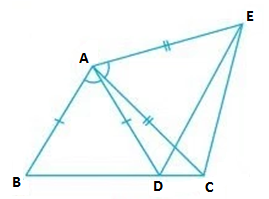
Sol.
Given that,
AC = AE, AB = AD and \(\angle\)BAD = \(\angle\)EAC
To show,
BC = DE
then Proof that,
\(\angle\)BAD = \(\angle\)EAC (Adding \(\angle\)DAC both sides)
\(\angle\)BAD + \(\angle\)DAC = \(\angle\)EAC + \(\angle\)DAC
\(\Rightarrow\) \(\angle\)BAC = \(\angle\)EAD
In \(\Delta\)ABC and \(\Delta\)ADE,
AC = AE (Given)
\(\angle\)BAC = \(\angle\)EAD
AB = AD (Given)
Therefore, \(\Delta\)ABC \(\cong\) \(\cong\)\(\Delta\)ADE by SAS congruence condition.
BC = DE by CPCT.
7. AB is a line segment and P is its mid-point. D and E are points on the same side of AB such that \(\angle\)BAD = \(\angle\)ABE and \(\angle\)EPA = \(\angle\)DPB . Show that
(i) \(\Delta\)DAP \(\cong\) \(\Delta\)EBP
(ii) AD = BE
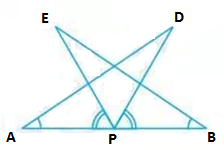
Sol.
Given,
P is mid-point of AB.
\(\angle\)BAD = \(\angle\)ABE and \(\angle\)EPA = \(\angle\)DPB
(i) \(\angle\)EPA =\(\angle\)DPB (Adding \(\angle\)DPE both sides)
\(\angle\)EPA + \(\angle\)DPE = \(\angle\)DPB + \(\angle\)DPE
\(\Rightarrow\) \(\angle\)DPA = \(\angle\)EPB
In \(\Delta\)DAP \(\cong\) \(\Delta\)EBP,
\(\angle\)DPA = \(\angle\)EPB
AP = BP (P is mid-point of AB)
\(\angle\)BAD =\(\angle\)ABE (Given)
Therefore, \(\Delta\)DAP \(\cong\) \(\Delta\)EBP by ASA congruence condition.
(ii) AD = BE by CPCT.
8. A right triangle ABC, right angled at C, M is the mid-point of hypotenuse AB. C is joined to M and produced to a point D such that DM = CM. Point D is joined to point B. Show that:
(i) \(\Delta\)AMC \(\cong\) \(\Delta\)BMD
(ii) \(\angle\)DBC is a right angle.
(iii) \(\Delta\)DBC \(\cong\) \(\Delta\)ACB
(iv) CM = 1/2 AB
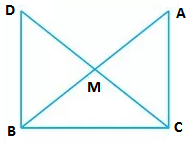
Sol.
Given,
\(\angle\)C = 90°, M is the mid-point of AB and DM = CM
(i) In \(\Delta\)AMC and \(\Delta\)BMD,
AM = BM (M is the mid-point)
\(\angle\)CMA = \(\angle\)DMB (Vertically opposite angles)
CM = DM (Given)
Therefore, \(\Delta\)AMC \(\cong\) \(\Delta\)BMD by SAS congruence condition.
(ii) \(\angle\)ACM = \(\angle\)BDM (by CPCT)
Therefore, AC || BD as alternate interior angles are equal.
Now,
\(\angle\)ACB + \(\angle\)DBC = 180° (co-interiors angles)
\(\Rightarrow\) 90° + \(\angle\)B = 180°
\(\Rightarrow\) \(\angle\)DBC = 90°
(iii) In \(\Delta\)DBC and \(\Delta\)ACB,
BC = CB (Common)
\(\angle\)ACB = \(\angle\)DBC (Right angles)
DB = AC
Therefore, \(\Delta\)DBC \(\cong\) \(\Delta\)ACB by SAS congruence condition.
(iv) DC = AB (\(\Delta\)DBC \(\cong\) \(\Delta\)ACB)
\(\Rightarrow\) DM = CM = AM = BM (M is mid-point)
\(\Rightarrow\) DM + CM = AM + BM
\(\Rightarrow\) CM + CM = AB
\(\Rightarrow\) CM = 1/2AB
Chapter =7.2
1. In an isosceles triangle ABC, with AB = AC, the bisectors of \(\angle\)B and \(\angle\)C intersect each other at O. Join A to O. Show that :
(a) OB = OC (b) AO bisects \(\angle\)A

Sol.
Sol. Given that,
AB = AC, the bisectors of \(\angle\)B and \(\angle\)C intersect each other at O
(i) Since ABC is an isosceles with AB = AC,
? \(\angle\)B = \(\angle\)C
? 1/2\(\angle\)B = 1/2\(\angle\)C
? \(\angle\)OBC = \(\angle\)OCB (Angle bisectors.)
? OB = OC (Side opposite to the equal angles are equal.)
(ii) In ?AOB and ?AOC,
AB = AC (Given)
AO = AO (Common)
OB = OC (Proved above)
Therefore, ?AOB ? ?AOC by SSS congruence condition.
\(\angle\)BAO = \(\angle\)CAO (by CPCT)
Thus, AO bisects \(\angle\)A.
2. In ?ABC, AD is the perpendicular bisector of BC . Show that ?ABC is an isosceles triangle in which AB = AC.
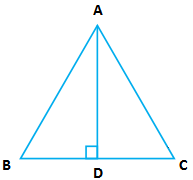
Sol.
Given,
AD is the perpendicular bisector of BC
To show,
AB = AC
Proof,
In ?ADB and ?ADC,
AD = AD (Common)
?ADB = ?ADC
BD = CD (AD is the perpendicular bisector)
Therefore, ?ADB ? ?ADC by SAS congruence condition.
AB = AC
3. ABC is an isosceles triangle in which altitudes BE and CF are drawn to equal sides AC and AB respectively. Show that these altitudes are equal.
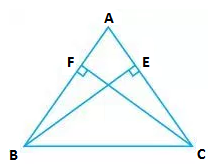
Sol.
Given that,
BE and CF are altitudes.
AC = AB
To show,
BE = CF
Proof,
In ?AEB and ?AFC,
?A = ?A (Common)
?AEB = ?AFC (Right angles)
AB = AC (Given)
Therefore, ?AEB ? ?AFC by AAS congruence condition.
Thus, BE = CF by CPCT.
4. ABC is a triangle in which altitudes BE and CF to sides AC and AB are equal . Show that
(i) ?ABE ? ?ACF
(ii) AB = AC, i.e., ABC is an isosceles triangle.
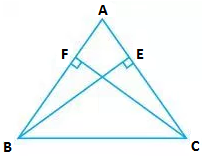
Sol.
Given,
BE = CF
(i) In ?ABE and ?ACF,
?A = ?A (Common)
?AEB = ?AFC (Right angles)
BE = CF (Given)
Therefore, ?ABE ? ?ACF by AAS congruence condition.
(ii) Thus, AB = AC by CPCT and therefore ABC is an isosceles triangle.
5. ABC and DBC are two isosceles triangles on the same base BC. Show that ?ABD = ?ACD.
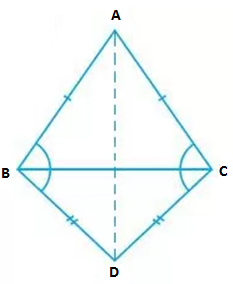
Sol.
Sol. Given that,
ABC and DBC are two isosceles triangles.
To show,
?ABD = ?ACD
Proof,
In ?ABD and ?ACD,
AD = AD (Common)
AB = AC (ABC is an isosceles triangle.)
BD = CD (BCD is an isosceles triangle.)
Therefore, ?ABD ? ?ACD by SSS congruence condition. Thus, ?ABD = ?ACD by CPCT.
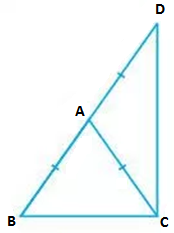
6. ?ABC is an isosceles triangle in which AB = AC. Side BA is produced to D such that AD = AB. Show that ?BCD is a right angle.
Sol.
Sol. Given that,
AB = AC and AD = AB
To show,
?BCD is a right angle.
Proof,
In ?ABC,
AB = AC (Given)
? ?ACB = ?ABC (Angles opposite to the equal sides are equal.)
In ?ACD,
AD = AB
? ?ADC = ?ACD (Angles opposite to the equal sides are equal.)
Now,
In ?ABC,
?CAB + ?ACB + ?ABC = 180°
? ?CAB + 2?ACB = 180°
? ?CAB = 180° – 2?ACB — (i)
Similarly in ?ADC,
?CAD = 180° – 2?ACD — (ii)
also,
?CAB + ?CAD = 180° (BD is a straight line.)
Adding (i) and (ii)
?CAB + ?CAD = 180° – 2?ACB + 180° – 2?ACD
? 180° = 360° – 2?ACB – 2?ACD
? 2(?ACB + ?ACD) = 180°
? ?BCD = 90°
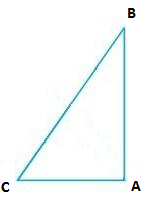
7.ABC is a right angled triangle in which ?A = 90° and AB = AC. Find ?B and ?C.
Sol.
Given,
?A = 90° and AB = AC
A/q,
AB = AC
? ?B = ?C (Angles opposite to the equal sides are equal.)
Now,
?A + ?B + ?C = 180° (Sum of the interior angles of the triangle.)
? 90° + 2?B = 180°
? 2?B = 90°
? ?B = 45°
Thus, ?B = ?C = 45°
8. Show that the angles of an equilateral triangle are 60° each.

Sol.
Let ABC be an equilateral triangle.
BC = AC = AB (Length of all sides is same)
? ?A = ?B = ?C (Sides opposite to the equal angles are equal.)
Also,
?A + ?B + ?C = 180°
? 3?A = 180°
? ?A = 60°
Therefore, ?A = ?B = ?C = 60°
Thus, the angles of an equilateral triangle are 60° each.