Maths Chapter-10: Practical Geometry
Exercise 10.1
Q1:
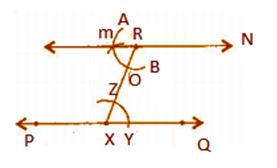
Draw a line and name it PQ, take a point R outside it. Through R, draw a line parallel to PQ using the ruler and compass only.
Solution:
To construct: A line, parallel to the given line by using ruler and compass.
Construction:
(i) Draw a line segment PQ and take a point R outside PQ.
(ii) Take any point X on PQ and join R to X.
(iii) With X as the center and take convenient radius, draw an arc cutting PQ at Y and RX at Z.
(iv) With R as center and the same radius as in step (iii), draw an arc AB cutting PX at O
(v) With the same arc YZ, draw the equal arc cutting AB at M.
(vi) Join MR to draw a line N.
This the required line PQ ? N
Q2 :
Draw a line N. Draw a perpendicular to N at any point on N. On this perpendicular choose a point P, 4cm away from N. Through A, draw a line P parallel to N.
Solution:
To construct: A line parallel to given line when perpendicular line is also given.
Construction:
(i) Draw a line N and take a point O on it.
(ii) At point O, draw a perpendicular line Q
(iii) Take OA = 4 cm on line Q.
(iv) At point A again draw a perpendicular line P
It is the required construction.

Q3:
Let X be a line and A be a point not on X. Through A, draw a line Y parallel to X. Now join A to any point B on X. Choose any point C on Y. Through C, draw a line parallel to AB. Let this meet X at P. What shape do the two sets of parallel lines enclose?
Solution:
To construct: A pair of parallel lines intersecting other part of parallel lines.
Construction:
(i) Draw a line X and take a point A outside of X
(ii) Take point B on line X and join AB
(iii) Make equal angle at point A such that Ð B = Ð A
(iv) Extend line at A to get line Y
(v) Similarly, take a point C which intersects at P on line X, draw line PC
Thus, we get parallelogram ABCP

Exercise 10.2
Q1 :
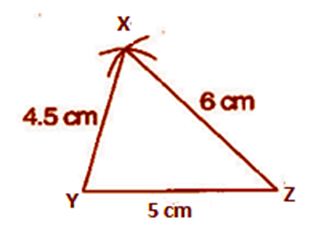
Construct \(\Delta\) PQR in which PQ = 4.5 cm , QR = 5 cm and RP = 6cm.
Solution:
Construct: \(\Delta\) PQR, where PQ = 4.5 cm, QR = 5 cm, RP = 6 cm
Construction:
(i) Draw a line segment QR = 5 cm.
(ii) Taking R as center and radius 6cm, draw arc.
(iii) Similarly, taking Q as center and radius 4.5 cm draw another arc which intersects the first arc at point P
(iv) Join PR and PR
It is the required \(\Delta\) PQR
Q2:
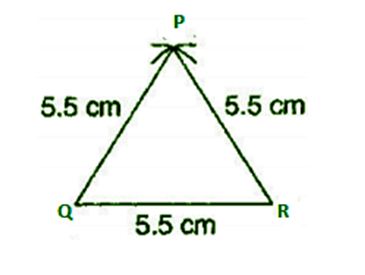
Construct an equilateral triangle of side 5.5 cm
Solution:
To construct: A \(\Delta\) PQR where PQ = QR = QP = 5.5 cm
Construction :
(i) Draw a line segment BC = 5.5 cm
(ii) Taking points Q and R as centers and radius 5.5 cm , draw arcs which intersect at point P.
(iii) Join PQ and PR
It is the required \(\Delta\) PQR
Q3:
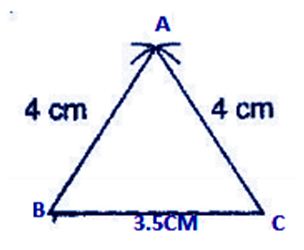
Draw \(\Delta\) ABC with AB = 4cm, BC = 3.5 and AC = 4cm. What type of triangle is this?
Solution:
To construct: \(\Delta\) ABC, in which AB = 4cm, BC = 3.5 and AC = 4 cm
Construction:
(i) draw a line segment BC = 3.5 cm
(ii) Taking B as center and radius 4 cm, draw an arc.
(iii) Similarly, taking C as center and radius 4 cm, draw another arc which intersects first arc at A.
(iv) Join AB and AC.
It is the required isosceles \(\Delta\) ABC
Q4:
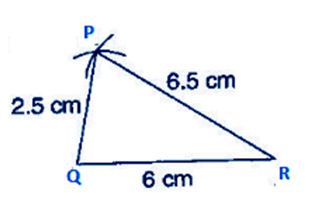
Construct \(\Delta\) PQR such that PQ = 2.5 cm , QR = 6 cm and PR = 6.5 cm. Measure \(\angle\) Q
Solution:
To Construct:
\(\Delta\) PQR such that PQ = 2.5 cm, QR = 6cm and PR = 6 cm and PR = 6.5 cm
Construction :
(i) Draw a line segment QR = 6cm
(ii) Taking B as center and radius 2.5 cm, draw an arc.
(iii) Similarly, taking C as center and radius 6.5 cm , draw another arc which intersects first arc at point P
(iv) Join PQ and PR
(v) Measure angle Q with the help of protractor
It is the required \(\Delta\) PQR where \(\angle\) Q = 80o
Exercise 10.3
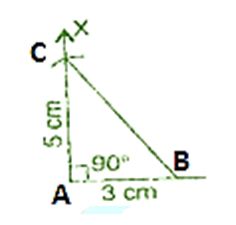
Q1: Construct a \(\Delta\) ABC so that AC = 5 cm, AB = 3 cm and \(\angle\) CAB = 90O .
Solution:
Constructing a \(\Delta\) DEF where DE = 5 cm, DF = 3 cm and m\(\angle\) EDF = 90O .
Steps of construction:
(a) Draw a line segment AB = 3 cm.
(b) At point A, draw an angle of 90O with the help of compass i.e., \(\angle\) XAB = 900.
(c) Taking A as the center, draw an arc of radius 5 cm, which cuts AX at the point E.
(d)Connect BC.
This is the required right angled triangle ACB:
Q2: Construct an isosceles triangle which has equal sides of length 6.5 cm and with a angle of 110 ° between them.
Solution:
Constructing an isosceles triangle where AC = AB = 6.5 cm and \(\angle\) A = 110 ° .
Steps of construction:
(a) Make a line segment AB= 6.5 cm.
(b) At A, make a \(\angle\) 110° with the help of protractor, i.e., \(\angle\) XAB = 110 ° .
(c) Take A as the center, and draw an arc of radius 6.5 cm, which cuts AX at point C.
(d) Connect BC
This is the required isosceles \(\Delta\) ABC:

Q3:
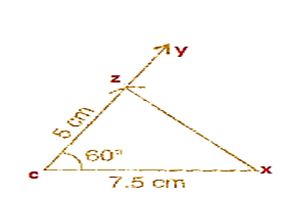
Construct a \(\Delta\) ZXC with XC = 7.5 cm, ZC = 5 cm and \(\angle\) C = 60O .
Solution:
Constructing a \(\Delta\) ZXC where XC = 7.5 cm, ZC = 5 cm and \(\angle\) C = 60O.
Steps of construction:
(a) Make a line segment XC = 7.5 cm.
(b) At C, make an angle of 600 with the help of protractor, i.e., \(\angle\) XCB = 60O .
(c) Take C as the center and draw an arc of 5cm, which cuts the line YC at the point Z.
(d)Connect AB
Thus, this is the required \(\Delta\) ZXC:
Exercise 10.4
Q1:
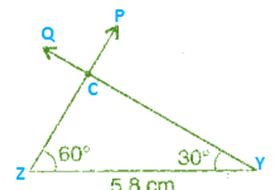
Construct a triangle ZXC, where\(\angle\) Z = 60O , \(\angle\) X = 30O and ZX = 5.8 cm.
Solution:
Now, constructing a \(\Delta\) ZXC where \(\angle\) Z = 60O , \(\angle\) X = 300 and ZX = 5.8 cm.
Steps for construction:
(a) Make a line segment ZX = 5.8 cm.
(b) At Z, make an angle \(\angle\) XZC = 60O with a compass.
(c) At X, draw \(\angle\) QXZ = 300 with a compass.
(d) ZP and XQ intersect at the point C.
Thus we have the required triangle ZXC:
Q2:
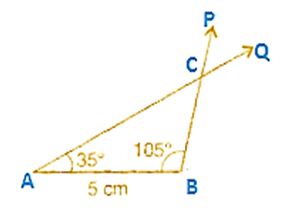
Construct a triangle ABC if AB = 5 cm, \(\angle\) ABC = 105° and \(\angle\) BCA = 40°.
Solution:
Given:
\(\angle\)ABC = 105° and \(\angle\) BAC = 40°
We know ,sum of the angles of a triangle = 180 .°
\(\angle\) ABC + \(\angle\) BCA + \(\angle\) CAB = 180°
105. 40 °+ 40°+\(\angle\)BCA = 180°
145° + \(\angle\) BCA = 180°
\(\angle\)BCA = 180° – 145°
\(\angle\)BCA = 35°
Constructing a triangle ABC whose\(\angle\) A = 35°, \(\angle\) B = 105° and AB = 5 cm.
Steps of construction:
(a) Make a line segment PQ = 5 cm.
(b) At A, make an angle \(\angle\) QAB = 35° with the help of a protractor.
(c) At B, make an angle \(\angle\) ABP = 105° with the help of a protractor.
(d) QA and BP intersect at point C.
Thus, we have the required triangle ABC.
Q3:
Can you construct a \(\Delta\) ABC such that AB = 4 cm, \(\angle\) B = 120° and \(\angle\) C= 70 °. Explain your answer.
Solution:
Given:
In \(\Delta\) ABC, \(\angle\) A = 120° and m\(\angle\) F = 70 °
We know the angles of a triangle sum up to 180o
Thus, we have
\(\angle\)A + \(\angle\)C+ \(\angle\)B= 180°
?\(\angle\)A + 120° + 70° = 180°
?\(\angle\)A + 190° = 180°
?\(\angle\)A = 180° ? 190° = ?10°
Since the sum of the angles is coming more than 180o, this triangle construction is not possible.
Exercise 10.5
Q1:
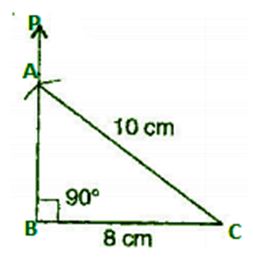
Construct a right angled \(\Delta\) ABC, where \(\angle\) B = 90o BC = 8 cm and AC = 10 cm
Solution:
To construct:
A right angled triangle ABC where \(\angle\) B = 90o BC = 8cm and AC = 10cm
Construction:
(i) Draw a line segment BC = 8cm
(ii) At point B, draw BP \(\perp\) BC
(iii) taking C as the center, draw an arc of radius 10cm
(iv) this arc cuts BP at point X
(V) join XB
It is the required right angled triangle ABC.
Q2 :
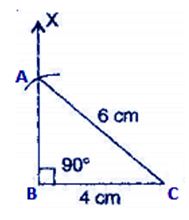
Construct a right angled triangle whose hypotenuse is 6cm long and one of the legs is 4cm long.
Solution:
TO construct:
A right angled triangle ABC where AC = 6cm and BC = 4cm
Construction:
(i) Draw a line segment BC = 4cm
(ii) At point X, draw BX \(\perp\) BC
(iii) Taking C as the center and radius 6cm, draw an arc. (Hypotenuse)
(iv) This arc cuts the BX at point A
(v) Join AC
It is the required right angled triangle ABC.
Q3 :
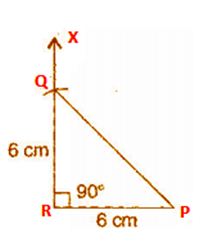
Construct an isosceles right angled triangle PQR, where \(\angle\)PQR = 90o and PR = 6cm.
Solution:
To construct:
An isosceles right triangle PQR where \(\angle\)R = 90o, PR = QR = 6cm
Construction:
(i) Draw a line segment PR = 6cm
(ii) At point R, draw XR \(\perp\) RP
(iii) Taking R as the center and radius 6 cm, draw an arc
(iv) This arc cuts RX at point Q
(v) Join QP
It is the required isosceles right angled triangle PQR