Maths Chapter-11: Perimeter and Area
Exercise 1:
Q1. Find
(a) the area of the land
(b) the price of the land,
If the land is of rectangular shape measuring 300 m in length and 400 m in breadth. The cost of 1m2 land is Rs. 10000.
Ans: (a) Area = Length (l) x Breadth (b)
= 300 x 400
= 120000 m2
(b) Cost of 1 m2 land = Rs 10000
Cost of 120000 m2 land = 10000 x 120000 = Rs 1200000000.
Q2. The perimeter of a park is 240m. Determine the area.
Ans: Perimeter = 240 m
4 x Length of a side of the park = 240
Length of a side of park = 240/4 = 60 m
Area = (Length of a side of park) 2 = (60)2 = 3600 m2
Q3. The area and length of a rectangular plot of land are 1200 m2 and 40 m respectively. Determine its perimeter.
Ans: Area = Length (l) x Breadth (b) = 1200 m2
= 40 x Breadth = 1200
= Breadth = 1200/40 = 30
Perimeter = 2 (Length (l) + Breadth (b) )
= 2 (30 + 40) = 2 (70) = 140 m
Q4. Find the breadth and area if the perimeter and length of the rectangular sheet is 120 cm and 40 cm respectively.
Ans: Perimeter = 2 (Length + Breadth) = 120 cm
2 (40 + Breadth) = 120
40 + b = 60
b = 6O – 40 =20 cm
Area = Length (l) x Breadth (b) = 40 x 20 = 800 cm2
Q5. The area of the rectangular park is equal to a square park. If the length of rectangular park measures 80m and the side of the square park is 100 m .Determine the breadth of the rectangular park.
Ans: Area of the square park = (side of the park)2 = (100)2 = 10000 m2
Area of the rectangular park = Length (l) x Breadth (b) = 10000
80 x Breadth = 10000
Breadth = 125 m
Q6. The length and breadth of a wire whose shape is a rectangle are 22 and 40 respectively. The wire is then reshaped into a square. Determine the side of the square and find out which shape encloses more area.
Ans: Perimeter of the rectangle = Perimeter of the square
2 (Length (l) + Breadth (b)) = 4 x Side
2 (22 + 40) = 4 x Side
2 x 62 = 4 x Side
Side =124/4 = 31 cm
Area of the rectangle = 22 x 40 = 880 cm2
Area of the square = (Side)2 = 31 x 31 = 961 cm2
Therefore, the square shaped wire encloses more area.
Q7. If the breadth and perimeter of a rectangle are 40 cm and 120 cm respectively, determine the length and area of the rectangle.
Ans: Perimeter = 2 (Length (l) + Breadth (b)) = 120
2 (Length + 40) = 120
Length + 40 = 60
Length = 60 – 40 = 20 cm
Area = Length (l) x Breadth (b) = 20 x 40 = 800 cm2
Q8. A door is fitted in a wall whose length measures 1 m and breadth measures 2 m. The length and breadth of the wall are 5 m and 3.5 m (in the given figure). The price of white washing the wall is Rs 10 per m2. Find the cost of whitewashing the wall without the door.
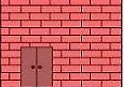
Ans: Area of the wall = 5 x 3.5 = 17.5 m2
Area of the door = 2x 1 = 2 m2
Area to be white-washed = 17.5 – 2 = 15.5 m2
Cost of white-washing 1 m2 area = Rs 10
Cost of white-washing 15.5 m2 area = 15.5 x 10 = Rs 155
Exercise 2:
Q1. Determine the area of the parallelograms in the diagram given below
Ans:
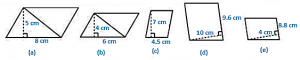
(a) Area of a parallelogram = Height x Base
Base = 8 cm
Height = 5 cm
Area = 8 x 5 = 40 cm2
(b) Area of a parallelogram = Height x Base
Base = 6 cm
Height = 4 cm
Area = 6 x 4 = 24 cm2
(c) Area of a parallelogram = Height x Base
Base = 4.5 cm
Height = 7 cm
Area = 4.5 x 7 = 31.5 cm2
(d) Area of a parallelogram = Height x Base
Base = 9.6 cm
Height = 10 cm
Area = 9.6 x 10 = 96 cm2
(e) Area of a parallelogram = Height x Base
Base = 8.8 cm
Height = 4 cm
Area = 8.8 x 4 = 35.2 cm2
Q2. Determine the area of the triangles .
Ans:

(a) Area of a triangle \(= \frac{1}{2}\times Base \times height\)
Height = 6 cm
Base = 8 cm
Area \(= \frac{1}{2}\times 8 \times 6\) = 48 cm2
(b) Area of a triangle \(= \frac{1}{2}\times Base \times height\)
Height = 6.4 cm
Base = 10 cm
Area \(= \frac{1}{2}\times 10 \times 6.4\) = 64 cm2
(c) Area of a triangle \(= \frac{1}{2}\times Base \times height\)
Height = 6 cm
Base = 8 cm
Area \(= \frac{1}{2}\times 8 \times 6\) = 48 cm2
(d) Area of a triangle \(= \frac{1}{2}\times Base \times height\)
Height = 4 cm
Base = 6 cm
Area \(= \frac{1}{2}\times 4 \times 6\) = 24 cm2
Q3. Fill the empty cells:
| S. No | Base | Height | Area of parallelogram |
| A | 10 cm | 124 cm2 | |
| B | 12 cm | 96 cm2 | |
| C | 7 cm | 91 cm2 | |
| D | 11 cm | 121 cm2 |
Ans:
(a) Area of a parallelogram = Height x Base
B = 10 cm
H =?
Area = 124 cm2
10 x h = 124
\(h = \frac{124}{10}=12.4\)
So, the height of the parallelogram is 12.4 cm
(b) Area of a parallelogram = Height x Base
B =?
H = 12 cm
Area = 96 cm2
b x 12 = 96
\(b = \frac{96}{12}=8\)
So, the base of the parallelogram is 8 cm
(c) Area of a parallelogram = Height x Base
B = 7 cm
H =?
Area = 91 cm2
7 x h = 91
\(h = \frac{91}{7}=13\)
So, the height of the parallelogram is 13 cm
(d) Area of a parallelogram = Height x Base
B = 11 cm
H =?
Area = 121 cm2
11 x h = 121
\(h = \frac{121}{11}=11\)
So, the height of the parallelogram is 11 cm
Q4. Fill in the blanks:
| Base | Height | Area of triangle |
| 12 | 24 cm2 | |
| 30 | 60 cm2 | |
| 22 | 66 cm2 |
Ans:
(a) Area of a triangle \(= \frac{1}{2}\times Base \times height\)
Height = ?
Base = 12 cm
Area \(= \frac{1}{2}\times Base \times height\) = 24 cm2
\(\frac{1}{2}\times 12 \times h = 24\) \(h = \frac{24\times 2}{12} = 4 cm\)
Therefore, the height of the triangle is 4 cm
(b) Area of a triangle \(= \frac{1}{2}\times Base \times height\)
Height = 30 cm
Base = ?
Area \(= \frac{1}{2}\times Base \times height\) = 60 cm2
\(\frac{1}{2}\times b \times 30 = 60\) \(h = \frac{60\times 2}{30} = 4 cm\)
Therefore, the base of the triangle is 4 cm
(c) Area of a triangle \(= \frac{1}{2}\times Base \times height\)
Height =?
Base = 22 cm
Area \(= \frac{1}{2}\times Base \times height\) = 66 cm2
\(\frac{1}{2}\times 22 \times h = 24\) \(h = \frac{66\times 2}{22} = 6 cm\)
Therefore, the height of the triangle is 6 cm.
Q5. ABCD is a parallelogram (in the given figure). BX is the height from B to CD and BY is the height from B to AD. If CD = 12 cm and BX = 7.6 cm.
Find: (a) the area of the parallelogram ABCD
(b) BY, if AD = 8 cm.
Ans:
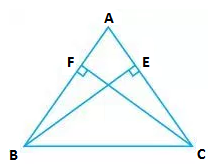
(a) Area of parallelogram = Base x Height = CD x BX
= 7.6 x 12 = 91.2 cm2
(b) Area of parallelogram = Base x Height = AD x BY = 91.2 cm2
BY x 8 = 91.2
BY = 91.2/8 =11.4 cm
Q6. SL and QM are the heights on sides PQ and PS respectively of parallelogram PQRS (in the given figure). If area of parallelogram is 1470 cm2, AB = 35 cm and AD = 49 cm, find the length of BM and DL.
`Ans:
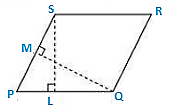
Area of a parallelogram = Height x Base = PQ x SL
1470 = 35 x SL
DL = \(\frac{1470}{35}\) = 42 cm
Also, PS x QM = 1470
1470 = 49 x QM
\(QM = \frac{1470}{35} = 30\ cm\)
Q7. ABC is right angled at A (in the given figure). AD Is perpendicular to BC. If AB = 5 cm, BC = 13 cm and AC = 12 cm, determine the area of triangle ABC. Also find the length of AD.
Ans:
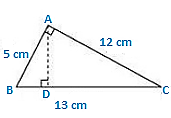
Area of a triangle \(= \frac{1}{2}\times Base \times height\) \(= \frac{1}{2}\times 5 \times 12\) = 30 cm2
Also, area of triangle \(= \frac{1}{2}\times AD \times BC\)
\( 30 = \frac{1}{2}\times AD \times 13\) \(\frac{30\times 2}{13}= AD\)
AD = 4.6 cm
Q8. Triangle ABC is isosceles with AB = AC = 7.5 cm and BC = 9 cm (in the given figure). The height AD from A to BC is 6 cm. Find the area of triangle ABC. What will be the height from C to AB i.e., CE?
Ans:
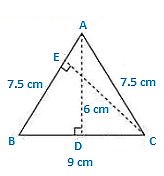
Area of triangle ABC \(= \frac{1}{2}\times Base \times height\) \(= \frac{1}{2}\times BC \times AD\)
\(= \frac{1}{2}\times 9 \times 6 = 27 cm2 \)
Area of triangle ABC \(= \frac{1}{2}\times Base \times height\) \(= \frac{1}{2}\times AB \times CE\)
\(27= \frac{1}{2}\times 7.5 \times CE\)
CE = 7.2