Science Chapter-03: Fibre to Fabric
- Is silkworm a larva or a caterpillar? Or both?
Ans. Both
- From the following animals, choose the one not suitable for wool extraction.
1- Goat
2-Camel
3- Yak
4- Wooly Dog
Ans. Wooly Dog
- Write a short note on the following.
(a) Rearing (b) Shearing (c) Sericulture
Ans.
(a) Rearing: It is a process of breeding, feeding and providing medical care to useful animals. These animals are kept since they produce one or more useful products for the human beings.
(b) Shearing: It is the process of removing fleece from the sheep along with a thin layer of skin.
(c) Sericulture: It is the rearing of silkworms to obtain silk is known as sericulture.
- Draw a sketch of the 2 stages involved in the life history of a silk moth which is directly involved in the production of silk.
Ans.
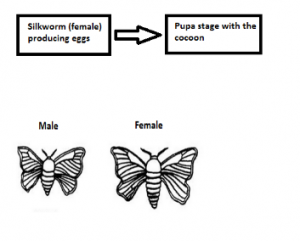
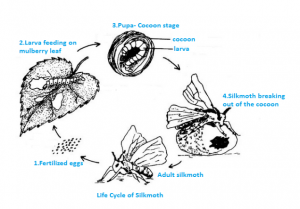
- In the following, identify the 2 terms related to silk production:
Sericulture, floriculture apiculture, moriculture, and silviculture.
Ans. Sericulture, Moriculture.
- Match the following
| Column I | Column II |
| 1. Scouring
2. Mulberry Leaves 3. Yak 4. Cocoon |
(a) Yields silk fiber
(b) Wool yielding animal (c) Food of silkworm (d) Reeling (e) Cleaning sheared skin |
Ans.
| Column I | Column II |
| 1. Scouring
2. Mulberry Leaves 3. Yak 4. Cocoon |
(e) Cleaning sheared skin
(c) Food of silkworm (b) Wool yielding animal (a) Yields silk fiber |
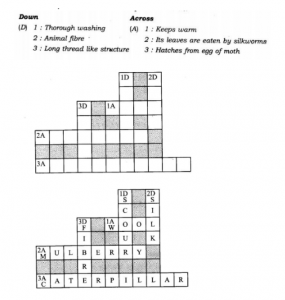
- The below crossword puzzle is from this chapter. Use the hints.
- You must be familiar with the following rhymes:
(a) ’Baa baa black sheep, have you any wool.’
(b) ‘Mary had a little lamb, whose fleece was white as snow.’
Answer the following:
(i) Which part of the black sheep has wool?
(ii) What is meant by the white fleece of the lamb?
Ans:
(i) Black sheep has wool on its hairy skin called fleece.
(ii) White fleece of the lamb refers to the white colored hairy skin.
- Fill the missing steps in the sequence of steps involved in silk processing.
Shearing, _______, Sorting, _______, ________.
Ans. Shearing, scouring, sorting, picking out of burrs, colouring. rolling.