Jawaharlal Nehru
Jawaharlal Nehru was a great Indian of the last century, next only to Mahatma Gandhi, the Father of the Nation. As Independent India’s first Prime Minister for seventeen long formative and eventful years, he has left a lasting impression on the country and the world. He was respectfully called ‘Panditji’. Nehru believed in a strong, united, industrialized and modern India.
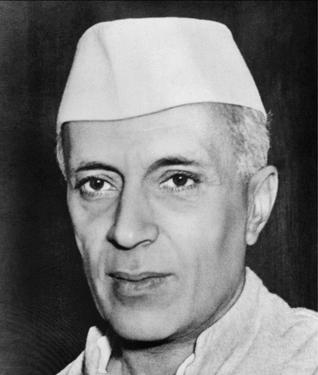
Panditji’s vision of free India had been formed clearly during the hard and tumultuous years of the freedom movement. At the age of 15, he went to England for higher education. After completing his education he started legal practice at Allahabad. However, he soon gave it up and joined the Freedom Movement. Nehru was impressed by Gandhiji’s Champaran (Bihar) and Kaira (Gujarat) movements.
Panditji in his Autobiography says “I was thrown, almost without any will of my own, into contact with the peasantry”. But this contact subsequently, influenced his mental outlook greatly.
Describing the kisans of Pratapgarh he says, “Looking at them and their misery and overflowing gratitude, I was filled with shame and sorrow, shame at my easy-going and comfortable life and our petty politics of the city which ignored this vast multitude of semi-naked sons and daughters of India, sorrow at the degradation and overwhelming poverty of India. A new picture of India seemed to rise before me, naked, starving, crushed and utterly miserable. And their faith in us, casual visitors from the distant city, embarrassed me and filled me with a new responsibility that frightened me”.
When India became free, Nehruji pledged to build the nation, eradicate poverty and ignorance, disease and inequality of opportunity and work for the good of the people. He initiated several measures to improve the lot of Indian farmers. The Zamindari System was abolished and land reforms were effected. For all round development of the country democratic planning was started in 1951 and Community Development Programmes in 1952. The policies and development programmes initiated by Pandit Nehru were successful and the country marched steadily on the path of progress.
In 1963 in an article Pandit Nehru himself described the measures taken by him and their success: “It is no sign of complacency to recognize that these policies have met with an encouraging measure of success. India remains the largest functioning democracy in the world. Without deviating from democratic principles and procedures, She has launched upon extensive programmes of modernization which are already bearing fruit. Far-reaching land reforms have taken place and our economy, still predominantly agricultural, is being steadily transformed by the spread of industrialization and the completion of vast new projects in the field of power, transport and irrigation. Our community development schemes represent a rural reconstruction programme which promises to transform the country – side and the vast population that lives there”.
Dedication and Sacrifice
Pandit Nehru was born in a rich and modern family. He lived a life of comfort and luxury from his childhood. He devoted himself to his country from the time of his earliest years. He returned to India from England in 1912 and got married in 1916 to Kamal Kaul who stood by him throughout all the joys and tribulations of his life until her death in 1936 leaving behind her only child daughter Indira born in 1917. In 1918, Panditji was elected Secretary of the Home Rule League, Allahabad and in the same year he was elected to the All India Congress Committee of which he remained a member right to his last day. He was imprisoned for the first time in 1921.
Apostle of Peace
Pandit Nehru made a great contribution to world peace. His stature in the International plane was unrivalled; his was the voice of sanity, morality and hope. Pandit Nehru was vehemently opposed to colonialism and worked zealously for the liberation of the colonial people. He fought against apartheid, and at his instance, this question was raised several times in the United Nations.
According to Bertrand Russell “It is a great tribute to him that he insisted that India should be non-aligned in the insane struggle for power which has preoccupied the United States and the Soviet Union at the expense of the welfare of mankind. Faced with overwhelming difficulties and pressures, Nehru insisted upon the role of mediator where he could have secured financial and military aid from whichever side he might have chosen to use”.
Pandit Jawaharlal Nehru was a great statesman. His contributions to India and the humanity cannot be shortlisted in a few pages. The then President of Egypt Gamal Abdel Nasser has aptly said, “To write on Jawaharlal Nehru is a source of great joy to one who does it. It provides him with an opportunity to contemplate on a life which in its length - 70 years - has not reached the same extent as it has in its depth and breadth”.