Rabindranath Tagore
Rabindranath Tagore is no more a monopoly of the Bengalees. The new copyright formulation ending the monopoly of Vishwabharati over Rabindranath Tagore’s literary and other creations has led to a better understanding of Tagore and his works.
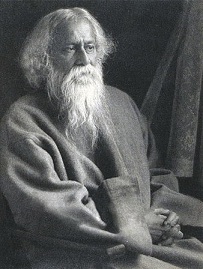
Sahitya Akademi in 1961, the centenary year of Rabindranath Tagore, published Tagore works in transliterated form. They are original Bengali works in Devanagri script. One can read the original books via their knowledge of the Devanagri script.
In literary creations, Rabindranath Tagore is looked upon as one of the greatest men of letters in the world. He coined approximately 1.5 million words to create all kinds of literature. These include about 55 books of 100 poems each, drama, dance-drama and plays numbering 47 titles, 20 novels, and 45 books of essays and volumes of letters of literary and civilisational value. Most of these were written in Bengali and English.
After World War-I, the European countries and the Latin American countries translated Tagore’s books in their own languages. An average of 40 titles each of Tagore have been translated in English, French, Russian, Spanish, Italian, German and other languages. Details of these translations are available with UNESCO.
In the present day era of linguistic watertight compartmentalism, people wonder why there should be so much of interest in knowing Tagore, the ‘Gurudev’ of Mahatma Gandhi. Pandit Jawaharlal Nehru, who sent his daughter Indira to Tagore’s Shantiniketan for schooling, once said: “Gurudev Rabindranath was a great poet, a great artist, a great patriot but he was, above all, a giant in a world of pigmie. Tagore and Gandhi, each in his different way, was the symbol of India, steeped in her ancient culture and drawing strength and sustenance”.
Tagore is the only poet who composed and tuned national anthems of two free countries - India and Bangladesh. The Indian National Anthem ‘Jana Gana Mana’ (in Bengali Jono Gono Mono) was written by the Nobel Laureate. It was first sung on December 27, 1911 at the Calcutta Session of Indian National Congress and later officially adopted by the Constituent Assembly as the National Anthem on January 24, 1950.
A multi-faceted personality, Rabindranath Tagore was a man with endless qualities. He was a thinker, a teacher and an educationist. He led the cooperative movement, implemented his format of rural work and development and at later stage of his life, kept himself busy in churning international conscience and warning world leaders of the “Crisis in Civilization” as an anti-war thinker. In politics, he did not involve himself actively but did not remain far away.
He was born on May 7, 1861 to Debendranath Tagore and Sharada Devi at Jorasanko in West Bengal. He did his schooling in the prestigious St. Xavier School. He has written thousands of Poems and lyrics and about 35 plays about 12 novels, numerous short stories and a mass of prose literature. He was called as ‘Vishwa Kavi’.
Besides the famous ‘Gitanjali’ for which he won the Noble Prize in 1913, his other well known poetic works include ‘Sonar Tari’, ‘Puravi’, ‘The cycle of the spring’, ‘The evening songs’ etc. The names of his well known novels are: ‘Gora’, ‘The wreck’, ‘Raja Rani’, ‘Ghare Baire’, ‘ Raj Rishi’ etc. ‘Chitra’ is his famous play in verse. ‘Kabuli Wallah’ and ‘Kshudita Pashan’ are his famous stories.
In 1901, he founded the Vishwabharati University - earlier known as Shantiniketan at Bolepur in West Bengal. This was founded with the aim of evolving a world culture, a synthesis of eastern and western values.